Seattle Apartment Move-Out Cleaning Checklist
A room-by-room Seattle apartment move-out cleaning checklist: what landlords check first, appliance steps, rough time estimates, and what cleaning does not cover.
The short answer
To clean a Seattle apartment for move-out, empty it completely, then work top to bottom and inside out: kitchen appliances first (oven, fridge, dishwasher, range hood), then bathrooms, then cabinets, closets, walls, windows, and floors last. Washington law asks tenants to restore the unit to its initial condition except for wear from ordinary use, so compare your work against your move-in checklist rather than a generic standard.
- RCW 59.18.130(10) asks tenants to restore the unit to its initial condition except for wear resulting from ordinary use. Your signed move-in checklist is the benchmark.
- Landlords tend to look first at the oven, refrigerator, bathroom fixtures, and floors, so give those the most time.
- Clean only after the unit is empty, and work top to bottom so dust and crumbs fall onto surfaces you have not cleaned yet.
- Cleaning is not repair: patching holes, painting, and carpet shampooing are separate tasks, and RCW 59.18.280 limits carpet cleaning charges unless the landlord documents wear beyond ordinary use.
- Budget most of a day for a one-bedroom in average condition, and more if the oven or bathroom has years of buildup.
This checklist is for Seattle renters cleaning an empty apartment before handing back the keys. It goes room by room in the order that saves the most time, flags what landlords and property managers tend to check first, and separates cleaning from the repairs and painting that a clean does not cover. Use it alongside your signed move-in checklist, which is the real benchmark for your unit.
For the rest of moving week (notice, utilities, keys), see the Seattle move-out checklist.
The standard you are cleaning to
Washington’s landlord-tenant act sets the bar. Under RCW 59.18.130(10), when the tenancy ends the tenant must “restore the premises to their initial condition except for wear resulting from ordinary use of the premises.” That is not a “spotless showroom” standard and it is not “good enough.” It is the condition recorded at move-in.
That record matters because RCW 59.18.260 requires a landlord who collects a deposit to give the tenant a written checklist at the start of the tenancy describing the condition and cleanliness of the unit, signed and dated by both. Find your copy before you start cleaning and use it to decide where to spend your time.
Two more rules shape the job:
- Ordinary wear is not a cleaning failure. RCW 59.18.280 says no portion of a deposit may be withheld for wear resulting from ordinary use. The City of Seattle’s renter guide gives faded paint, scuff marks on linoleum, and wear patterns on carpet as examples of reasonable wear and tear.
- Nonrefundable cleaning fees. If you paid one, RCW 59.18.130(10) says you shall not be charged for normal cleaning. The City of Seattle says a landlord cannot charge for cleaning at the end if they charged for cleaning at the start.
For the full picture of how deposits work, see Washington security deposit rules and what landlords can and cannot deduct. Nothing in a cleaning checklist can guarantee a deposit outcome; it can make sure cleanliness is not a reasonable point of dispute.
What landlords look at first
Property managers doing a move-out walkthrough tend to go straight to a handful of places where dirt is obvious and costly to fix. Give these your best effort and your most time:
- Inside the oven and the stovetop, including under the burner grates or drip pans.
- Inside the refrigerator and freezer, including drawers, door shelves, and the gasket.
- Bathroom fixtures: toilet base and behind it, tub or shower walls, grout, and the glass door if there is one.
- Floors, especially corners, along baseboards, and the strip in front of the kitchen counters.
- Cabinet and drawer interiors, where crumbs, grease, and shelf liner residue hide.
- Windowsills and window tracks, which collect grit and, in damp Seattle winters, condensation residue and mildew spots.
Before you start: setup and order
- Empty the unit completely. Every box, shelf liner you added, hook, and hanger.
- Keep power and water on through cleaning day. Schedule utility stops for the day you return the keys.
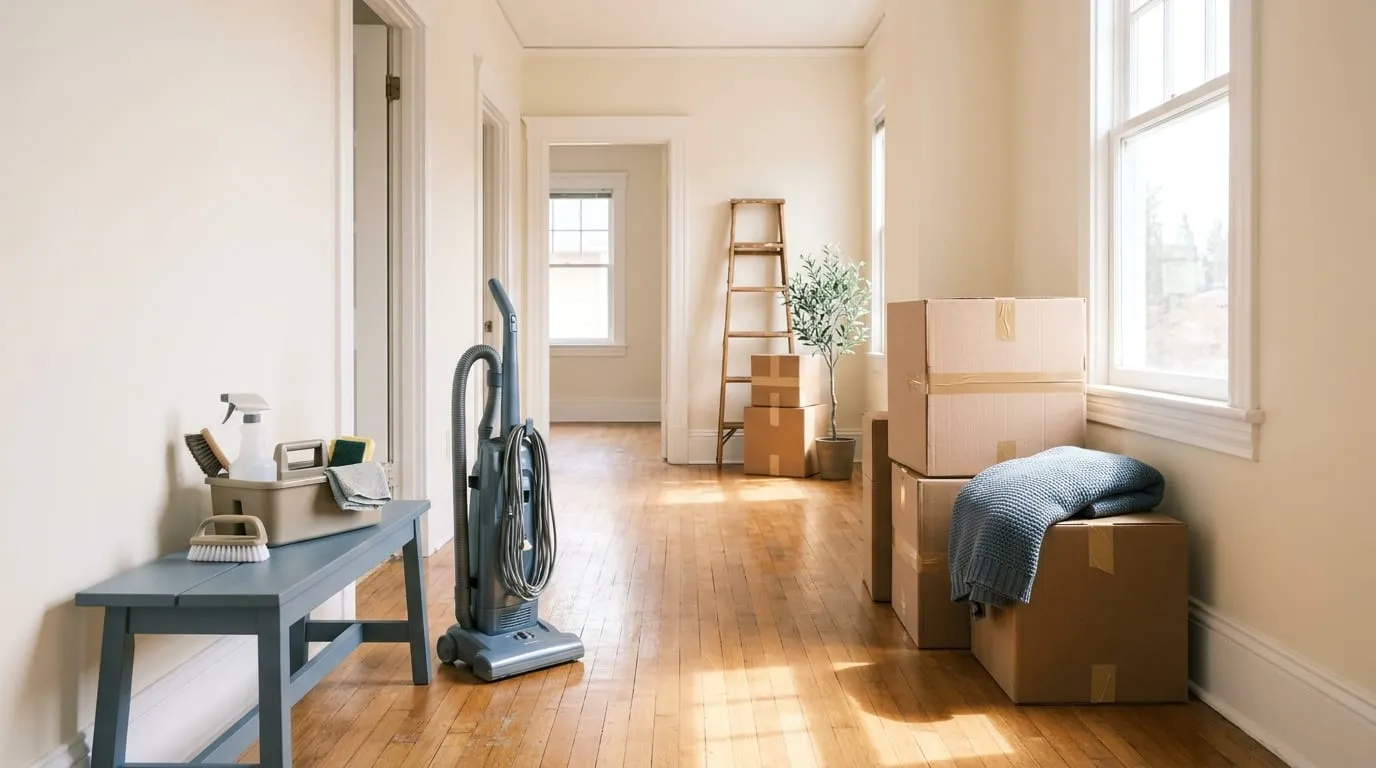
- Gather supplies: all-purpose cleaner, a degreaser, a bathroom cleaner, glass cleaner, a non-scratch scrub pad, a toothbrush or detail brush, microfiber cloths, a bucket, a mop suited to your floors, a vacuum with a crevice tool, trash bags, and a step stool.
- Follow every product label for dwell times and ventilation, open windows, and never mix products. Leftover chemicals you will not take with you go to a household hazardous waste facility, not down the drain or into the unit’s trash. Seattle Public Utilities lists free household hazardous waste drop-off sites for King County residents.
- Work top to bottom and inside out in each room: ceilings and light fixtures, then upper cabinets, walls and counters, lower cabinets, baseboards, and floors last.
Kitchen
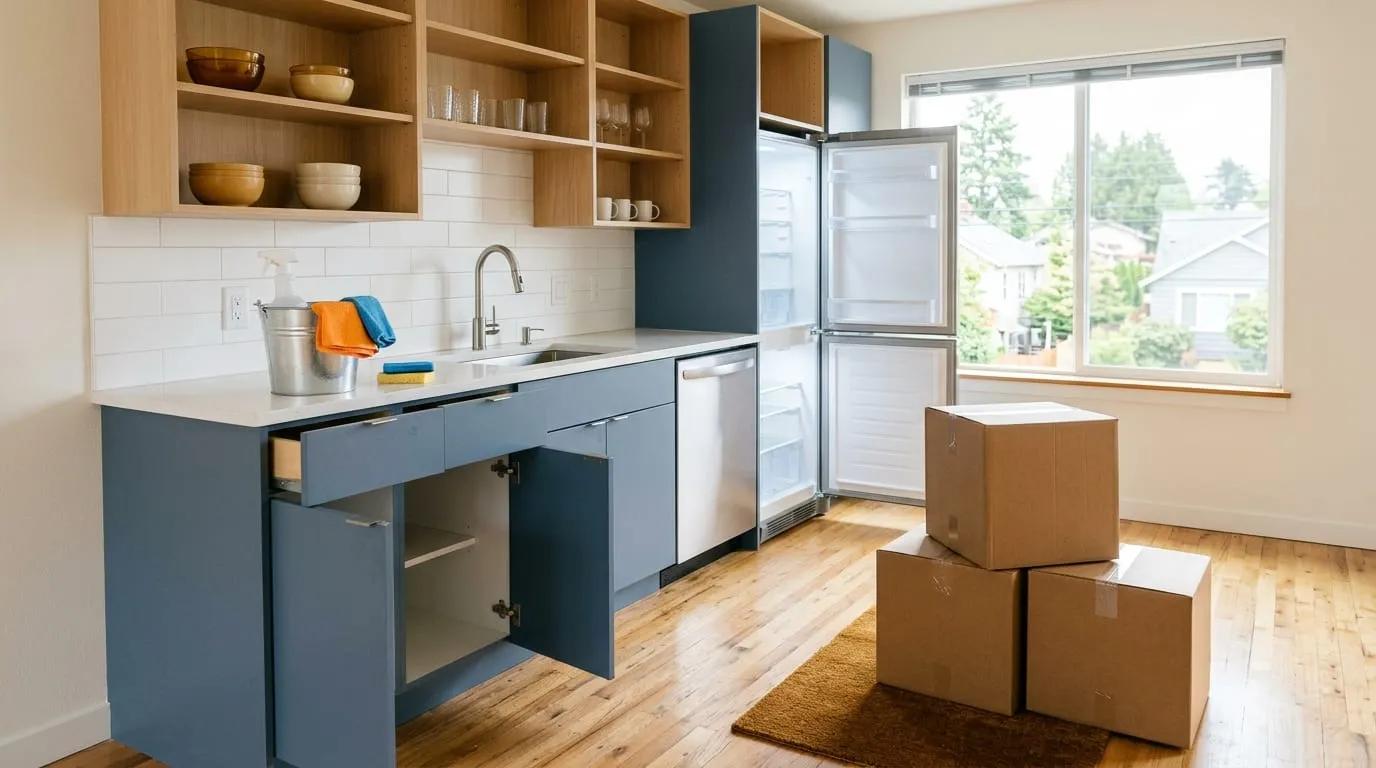
The kitchen takes the longest and gets the closest look. For full technique on degreasing and appliance cleaning, the Seattle Cleaning Guide’s kitchen deep cleaning guide goes step by step. Here is the move-out version.
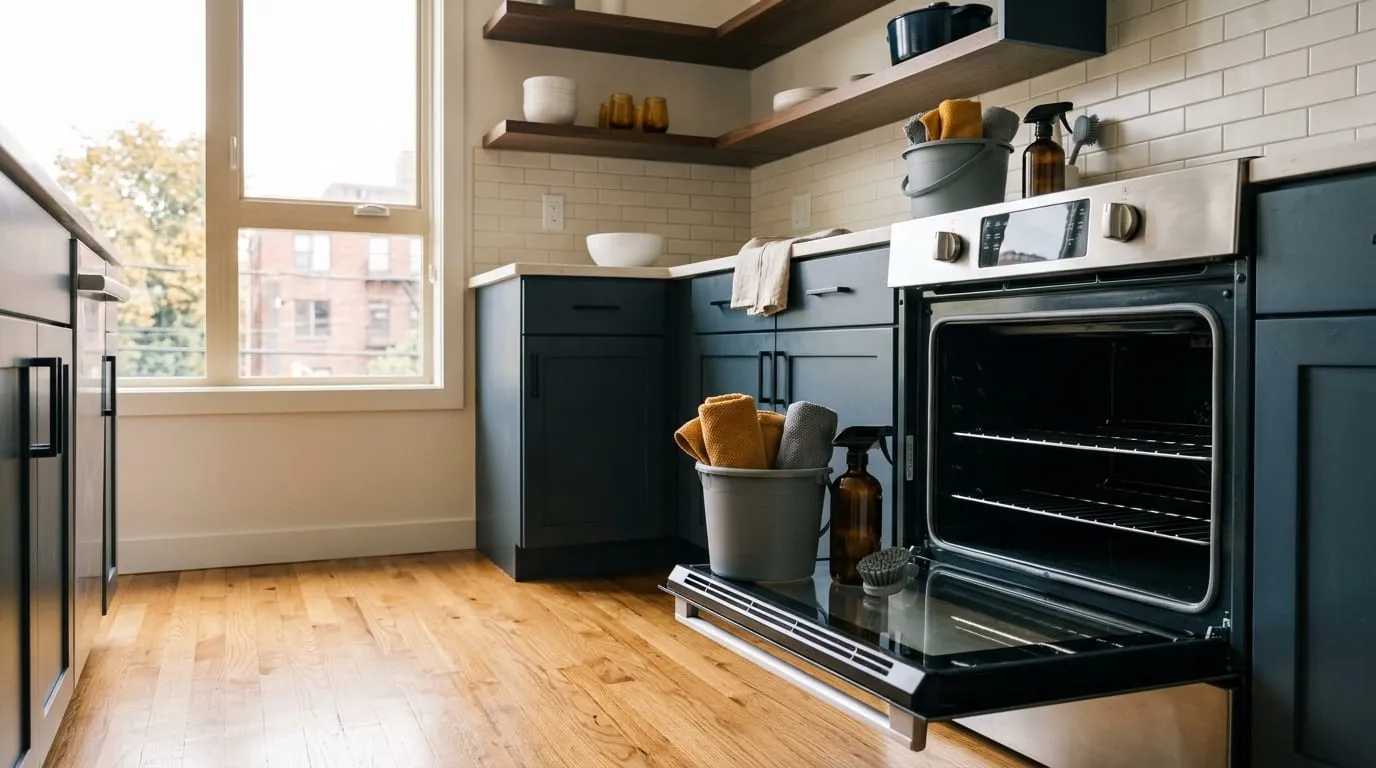
Oven and range
- Remove racks and soak or scrub them separately.
- Start the oven cleaning early, because most methods need dwell time. If you use a self-clean cycle, read the manual and ventilate; if you use a product, follow its label exactly.
- Wipe the door glass inside and out, and the seal area around the door without scrubbing the gasket hard.
- Gas range: lift grates and burner caps, wash them, and wipe the cooktop underneath. Electric coil range: remove drip pans and clean or check them against the move-in checklist. Glass cooktop: use a cleaner made for glass-ceramic surfaces and a flat scraper only as the manufacturer allows.
- Pull the range forward if it slides out safely and clean the floor and wall behind it, plus the sides of neighboring cabinets.
Range hood and microwave
- Wipe the hood exterior and underside, where grease collects.
- Remove metal mesh filters and degrease them if the manual says they are washable.
- Microwave: wipe the interior ceiling, walls, and turntable, plus the door seal and exterior.
Refrigerator and freezer
- Unplug only if the landlord expects it off; otherwise empty and clean it running.
- Remove shelves and drawers, wash them, and dry them before reinstalling.
- Wipe the interior walls, ceiling, door shelves, and the gasket folds, where mold spots appear in humid kitchens.
- Clean the exterior, top, and handles. Pull it out if safe and vacuum behind and underneath.
- Empty and wipe any ice bin.
Dishwasher, sink, and counters
- Clean the dishwasher filter (most twist out at the bottom), door edges, and spray arms.
- Scrub the sink basin and faucet base, and clear the drain stopper.
- Wipe counters, backsplash, and outlet covers.
Cabinets and drawers
- Vacuum crumbs, then wipe interiors, shelves, and drawer runners.
- Wipe exterior doors, especially around handles and the lower edges near the stove.
- Remove any shelf liner or adhesive hooks you installed.
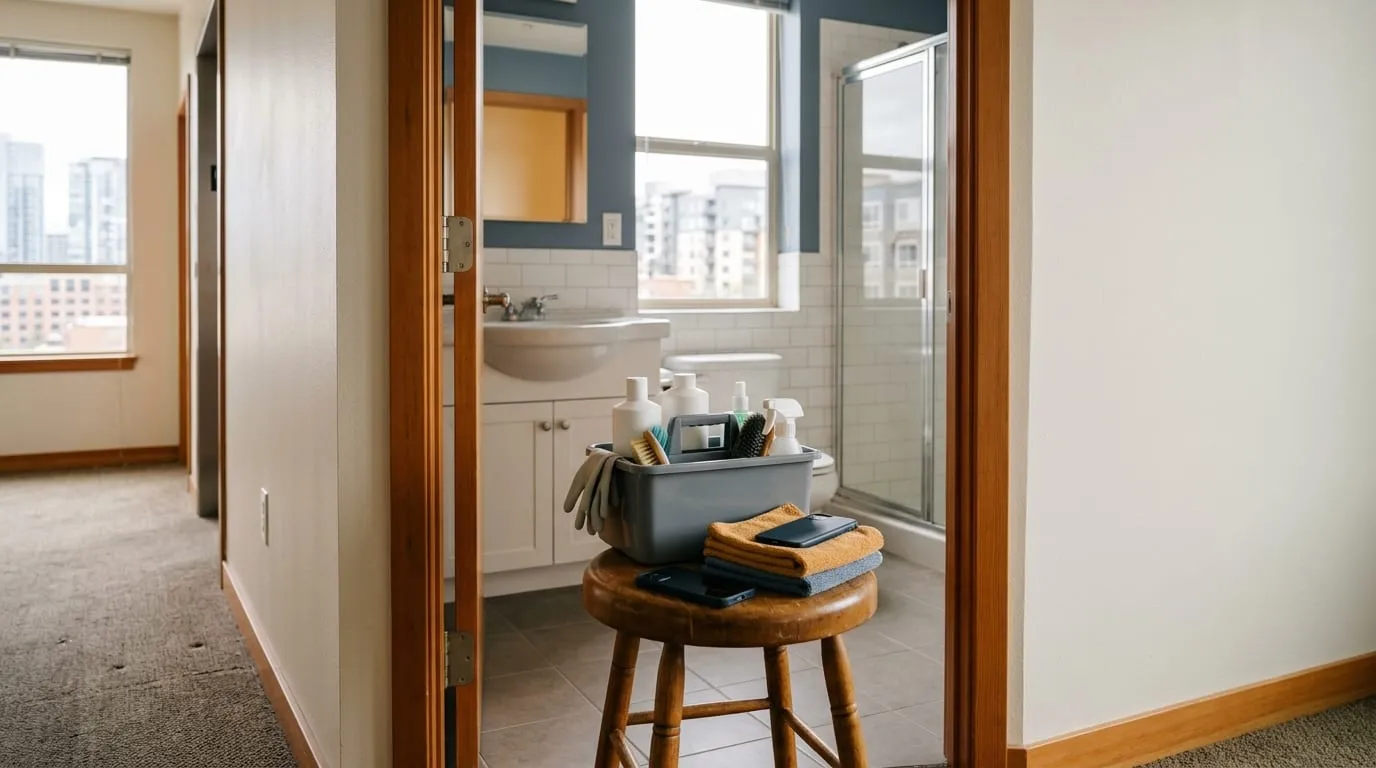
Bathrooms
- Spray the tub or shower with bathroom cleaner first so it can dwell while you do other tasks.
- Clean the toilet top to bottom: tank lid, handle, seat hinges, the base, and the floor and wall behind it.
- Scrub tub or shower walls, fixtures, and grout lines. Treat mildew spots per the product label; Seattle’s damp months make ceiling and caulk mildew common.
- Clean glass doors and tracks, or replace a shower curtain liner if you added it and it is mildewed (take it with you).
- Clean the sink, faucet, mirror, medicine cabinet inside and out, and vanity drawers.
- Wipe the exhaust fan cover and light fixtures.
- Mop last, getting behind the toilet and along the tub edge.
Living areas and bedrooms
- Dust ceiling fans, light fixtures, and the tops of door frames.
- Wipe light switches, outlet covers, door handles, and visible scuffs on walls with a damp cloth. Test any cleaner on a hidden spot first, since scrubbing flat paint can leave shiny patches.
- Remove nails, hooks, and adhesive strips you added, following the lease on whether to patch (see “What is not cleaning” below).
- Clean windowsills and slide tracks with a crevice tool and a damp cloth; wipe interior glass.
- Wipe blinds slat by slat, or follow the lease if blinds are washable.
- Wipe closet shelves and rods; vacuum closet floors.
- Wipe baseboards, then vacuum or mop floors last.
Entry, laundry, and extras
- Wipe the front door inside and out, the peephole area, and the threshold.
- Washer and dryer, if in-unit: clean the dryer lint trap, wipe the washer gasket and detergent drawer, and wipe exteriors and tops.
- Balcony or patio: sweep, remove plants and debris, and wipe the railing.
- Storage cage, assigned parking spot, or bike room space: empty it.
- Replace burned-out bulbs if your lease makes that the tenant’s job.
What is not cleaning
A move-out clean, whether you do it or hire it out, covers dirt, grease, dust, and residue. Several things renters often lump in with cleaning are actually repairs or separate services:
- Patching nail holes or larger wall holes. That is repair work. Whether small holes count as ordinary wear depends on the facts; Washington’s statute has no specific rule on nail holes.
- Painting or touch-up painting. Also repair, and touch-ups that do not match can look worse than the original wall.
- Carpet shampooing or steam extraction. A separate service. RCW 59.18.280 says no deposit may be withheld for carpet cleaning unless the landlord documents carpet wear beyond ordinary use.
- Replacing broken fixtures, blinds, or screens. Repair or replacement, governed by the deposit rules on documentation.
- Removing your belongings or large furniture. Hauling, not cleaning.
If any of these apply to your unit, handle them separately and check the deductions guide to understand how they are treated.
Printable move-out cleaning checklist
Print or copy this table. The time column is a rough editorial estimate for an empty one-bedroom in average condition, done by one person; heavy grease, long-term buildup, or a second bathroom can double it.
| Area | Tasks | Rough time | Done |
|---|---|---|---|
| Oven and range | Racks, interior, door glass, burners or drip pans, behind and beside range | 60 to 120 min | ☐ |
| Refrigerator | Shelves, drawers, walls, gasket, exterior, behind and under | 30 to 60 min | ☐ |
| Hood, microwave, dishwasher | Hood underside and filter, microwave interior, dishwasher filter and edges | 30 to 45 min | ☐ |
| Kitchen cabinets, counters, sink | Interiors, exteriors, counters, backsplash, sink and faucet | 30 to 60 min | ☐ |
| Bathroom | Toilet, tub or shower and grout, sink, mirror, cabinet, fan cover, floor | 60 to 90 min | ☐ |
| Walls and switches | Spot-clean scuffs, switches, outlets, door handles | 20 to 40 min | ☐ |
| Windows | Sills, tracks, interior glass, blinds | 30 to 60 min | ☐ |
| Closets | Shelves, rods, floors | 15 to 30 min | ☐ |
| Baseboards and doors | Wipe all baseboards, door faces, frames | 20 to 40 min | ☐ |
| Floors | Vacuum everywhere, mop hard floors last | 30 to 60 min | ☐ |
| Extras | Laundry appliances, balcony, storage, entry | 15 to 45 min | ☐ |
| Final pass | Walk every room with move-in checklist; photograph | 20 to 30 min | ☐ |
An illustrative example: a two-bedroom with a tired oven
Consider a hypothetical two-bedroom, one-bath apartment in Ballard rented for three years. The move-in checklist recorded the oven as “clean,” the carpet as “fair, some wear in hallway,” and the bathroom as “clean, minor grout staining.”
- The tenant starts with the oven, because the move-in checklist called it clean and three years of use left a baked-on floor. The oven product dwells per its label while the tenant empties and cleans the fridge.
- The hallway carpet still shows a wear path. That matches the move-in note and is ordinary wear, so the tenant vacuums thoroughly instead of renting an extractor.
- Grout staining in the bathroom was noted at move-in, so the tenant cleans it normally rather than trying to bleach it to brand new.
- Two picture-hanging holes in the living room are left as the lease directs, and the tenant photographs them.
- Last, the tenant walks each room with the move-in checklist in hand, photographs everything, and keeps the files. The documentation guide covers how to make those photos useful.
In this scenario the work took most of one day with two people. Your time will vary.
When to consider help
If you are running short on time, have heavy buildup, or are moving out of a large unit in the same week you start a new job, it may make sense to hand off some or all of the clean. DIY vs. professional move-out cleaning walks through that decision, and move-out cleaning cost in Seattle explains what drives the price of a quote.
Common questions
Do I have to shampoo the carpet when I move out of a Washington apartment?
State law limits it. RCW 59.18.280 says no part of the deposit may be withheld for carpet cleaning unless the landlord documents wear to the carpet beyond wear resulting from ordinary use. Vacuum thoroughly and treat any spots you caused, and read your lease, but a routine shampoo charge on its own is restricted.
Should I clean the inside of the oven if it came dirty at move-in?
Check your move-in checklist. The legal standard is the unit's initial condition, so if the checklist recorded a dirty oven, that is the baseline. In practice, cleaning it anyway removes an easy point of dispute and takes an hour or two.
My landlord charged a nonrefundable cleaning fee at move-in. Do I still need to clean?
RCW 59.18.130(10) says a tenant who paid a nonrefundable cleaning fee shall not be charged for normal cleaning, and the City of Seattle says the same. You still must remove your belongings and are still responsible for damage beyond ordinary wear, so a basic tidy and good photos are still worth doing.
Is it better to clean before or after the movers come?
After. Cleaning around furniture and boxes misses the floors and walls landlords look at most, and movers track in dirt. If you must prep earlier, do the inside of cabinets and appliances first, then do floors, baseboards, and bathrooms once the unit is empty.
Sources and references
- RCW 59.18.130 Duties of tenant , Washington State Legislature Primary source Accessed November 15, 2026
- RCW 59.18.280 Moneys paid as deposit or security, statement of basis for retention, remedies , Washington State Legislature Primary source Accessed November 15, 2026
- RCW 59.18.260 Moneys paid as deposit or security for performance by tenant, written rental agreement required, checklist , Washington State Legislature Primary source Accessed November 15, 2026
- Return of Your Security Deposit , City of Seattle, Renting in Seattle Primary source Accessed November 15, 2026
- Move in Costs , City of Seattle, Renting in Seattle Primary source Accessed November 15, 2026
- Where to Dispose of Household Hazardous Waste , Seattle Public Utilities Primary source Accessed November 15, 2026
See something out of date or wrong? Tell the editors. Read how we work in our editorial policy.