DIY vs. Professional Move-Out Cleaning
Should you clean your Seattle rental yourself or hire a move-out cleaner? Weigh moving-week time, equipment, condition, your lease, and what pros leave out.
The short answer
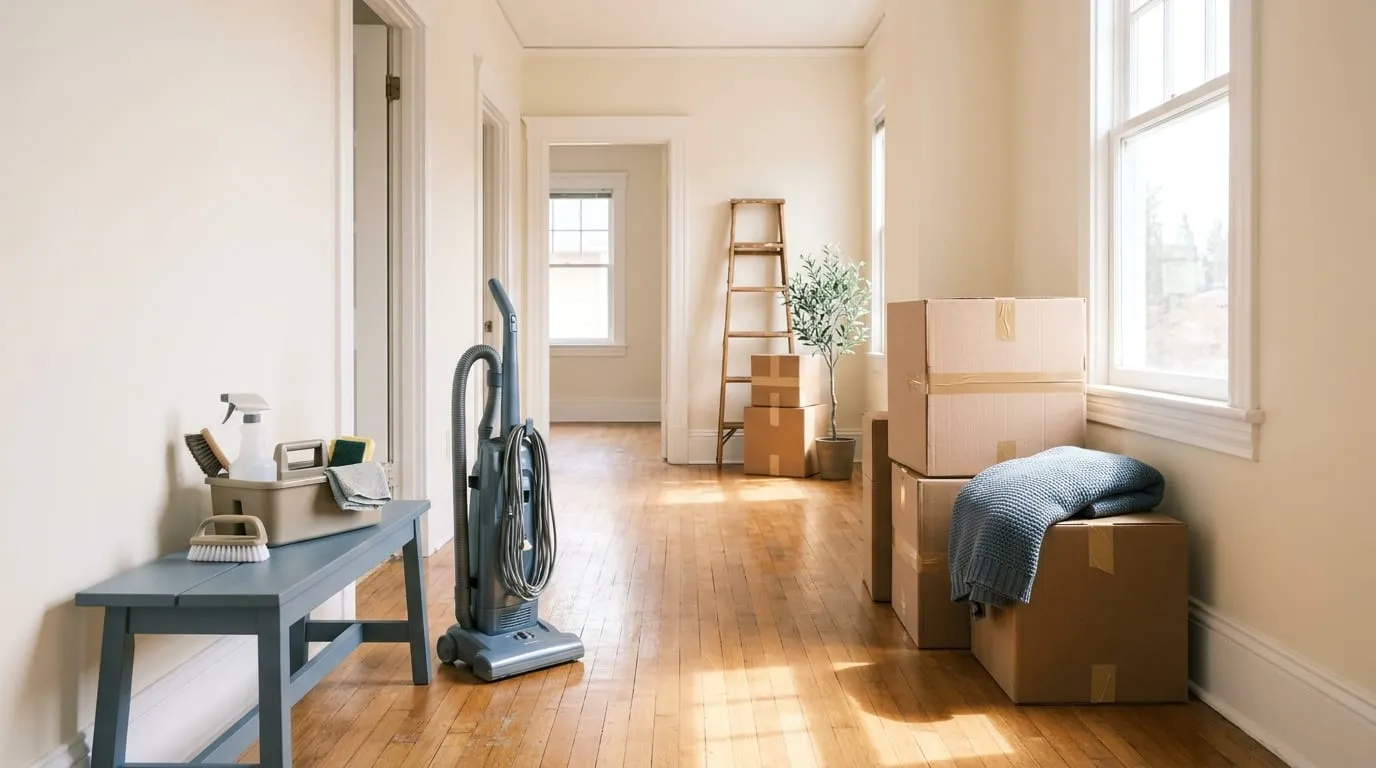
Clean it yourself if the unit is small, in fair shape, and you can give the empty apartment one uninterrupted day after the movers leave. Hire a move-out cleaner if moving week is already full, the oven or bathroom has years of buildup, or your lease or landlord's checklist asks for a standard you cannot reliably hit, and remember that carpet shampooing, patching, and painting are usually separate jobs either way.
- The real question is whether you will have one full, uninterrupted day in the empty unit. If not, DIY tends to become a rushed half clean.
- Your move-in checklist sets the legal benchmark. Washington asks tenants to restore the unit to its initial condition except for wear resulting from ordinary use.
- Read the lease cleaning clause before deciding. Some require professional carpet cleaning or receipts, and a nonrefundable cleaning fee changes the picture.
- Most move-out cleaners exclude carpet shampooing, wall patching, painting, exterior windows, and hauling, so plan those separately.
- A re-clean guarantee is only useful if you understand its time window and how to report a problem. Ask before you book.
This guide is for Seattle renters deciding whether to clean their own unit on the way out or pay someone to do it. It is about the move-out clean only, the one that sits between the moving truck and the key return. If you are weighing ongoing or recurring house cleaning help instead, the Seattle Cleaning Guide covers that in professional cleaning vs. DIY.
The short version: DIY works when the unit is small, in fair condition, and you can protect one uninterrupted day in the empty apartment. Hiring help makes sense when moving week is already overloaded, there is heavy buildup, or your lease sets a standard you cannot reliably meet. The rest of this article helps you figure out which side of that line you are on.
Why the move-out clean is a different decision
A routine clean is about living comfortably. A move-out clean is about meeting a specific benchmark on a specific day, and three things make it unlike any other cleaning job.
The benchmark is written down. Under RCW 59.18.130(10), a tenant must “restore the premises to their initial condition except for wear resulting from ordinary use of the premises.” The initial condition is recorded in the move-in checklist that RCW 59.18.260 requires a landlord to provide before collecting a deposit. Whoever does the work, the target is that document, not an abstract idea of spotless.
The window is short. You cannot do the real work until the furniture and boxes are out, and you usually must hand back keys within a day or two of that. Every hour of delay from the movers, the elevator, or a late truck comes straight out of cleaning time.
Someone will inspect it. A landlord or property manager walks the unit afterward and decides whether to charge for cleaning. That is why the oven, refrigerator, bathroom fixtures, and floors deserve the most attention; our move-out cleaning checklist covers those room by room.
Start with time: the honest moving-week audit
Most DIY move-out cleans that go wrong fail on time, not skill. Before deciding, list what moving week actually holds:
- When the movers or your truck leave the unit.
- When you must return keys or the landlord’s inspection is scheduled.
- Work shifts, childcare, and any travel to the new place.
- Utility shutoff dates. You need power, water, and light to clean, so schedule the stops for key day, not before.
- Elevator reservations, loading zone time, and any building rules on move hours.
Now subtract. If the gap between empty unit and key return is less than a full day, or that day is shared with driving a truck, unloading at the new place, or a work shift, DIY is at real risk of becoming a fast wipe-down. As a rough editorial estimate, an empty one-bedroom in average condition takes one person most of a day, and a two-bedroom with heavy oven or bathroom buildup can take two people a full day. Your time will vary.
Seattle factors that eat the clock
- Stairs and walk-ups. Older Seattle buildings often lack elevators, so every trip for supplies and trash is a climb.
- Shared elevators. Many apartment buildings require reservations for move use. If your reserved slot runs late, the clean starts late.
- Parking. In dense neighborhoods, finding a spot to unload supplies can take a while. The City’s temporary no parking zone process is aimed at moving vans and trucks, so plan your own car or a cleaner’s vehicle around street parking.
- Dark, damp afternoons. In winter you lose daylight early, and an empty unit has no lamps. Bring a work light if the overhead fixtures are dim.
Equipment and supplies
DIY looks free until you list what a full move-out clean uses. You will want an all-purpose cleaner, a degreaser, a bathroom cleaner, a glass cleaner, an oven product or a plan for the self-clean cycle, non-scratch pads, detail brushes, a stack of microfiber cloths, a bucket, a mop that suits your floors, a vacuum with a crevice tool, a step stool or ladder, and plenty of trash bags.
If you already own most of this, DIY costs mainly your time. If you just packed it all into a truck, or you are moving across the country and do not want to carry half-empty bottles, the supply question tilts toward hiring. Follow every product label for dwell time and ventilation, never mix products, and take leftover chemicals with you or to a household hazardous waste site rather than leaving them under the sink.
The carpet question
Carpet is where people over-buy. Renting an extractor and doing the whole unit is a big job. Before you do it, check two things. First, your lease: some require professional carpet cleaning at move-out. Second, Washington law: RCW 59.18.280 says no portion of a deposit may be withheld for carpet cleaning unless the landlord documents wear to the carpet beyond wear resulting from ordinary use. The Carpet and Rug Institute recommends deep cleaning every 12 to 18 months and thorough vacuuming in between, so if you have kept up with that, a careful vacuum and spot treatment may be enough. Many move-out cleaners do not shampoo carpets at all, so either way it is usually a separate decision.
Condition: how much buildup are you facing?
Be honest about the unit’s state, room by room. Light dust and surface grime are DIY territory for almost anyone. These are the signs a job is heavier than it looks:
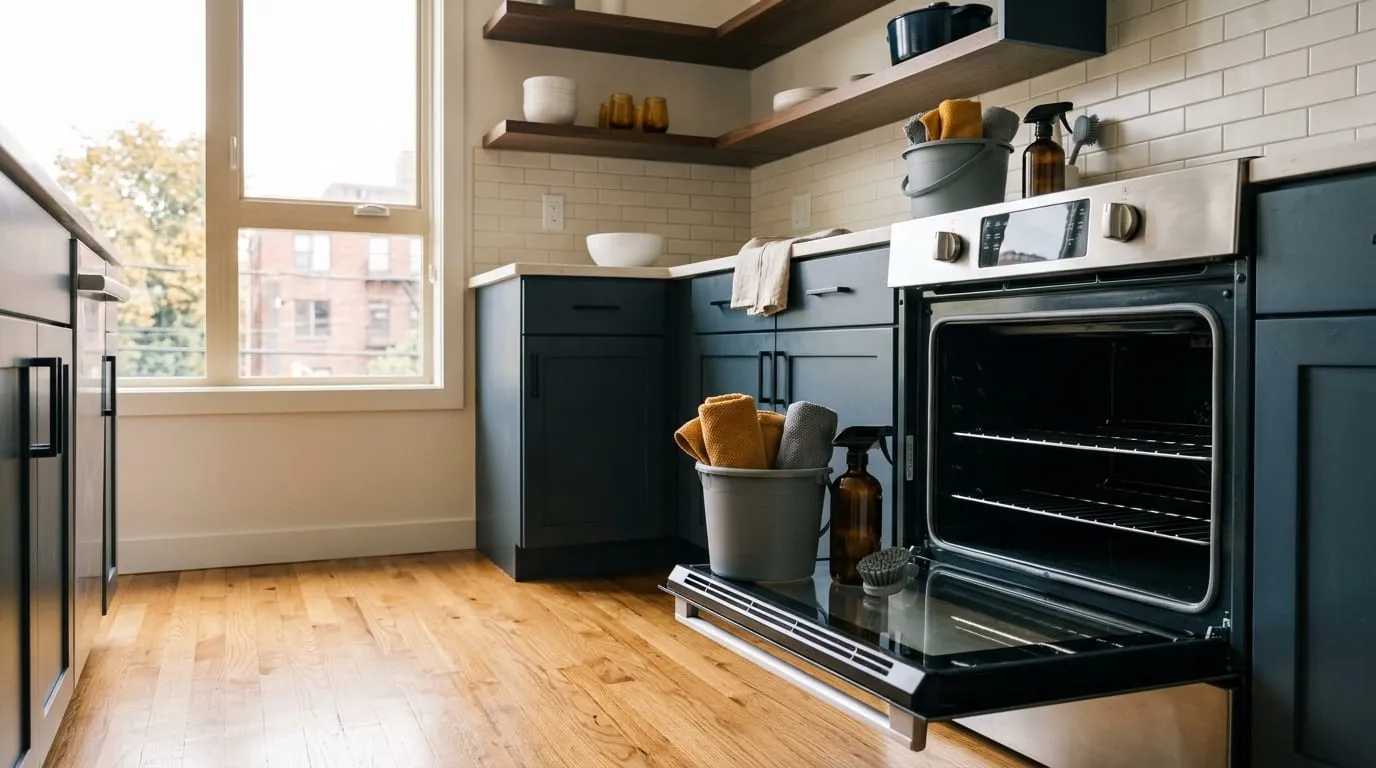
- Baked-on carbon on the oven floor or door glass from years of use.
- Grease film on the range hood, the cabinet faces near the stove, and the top of the refrigerator.
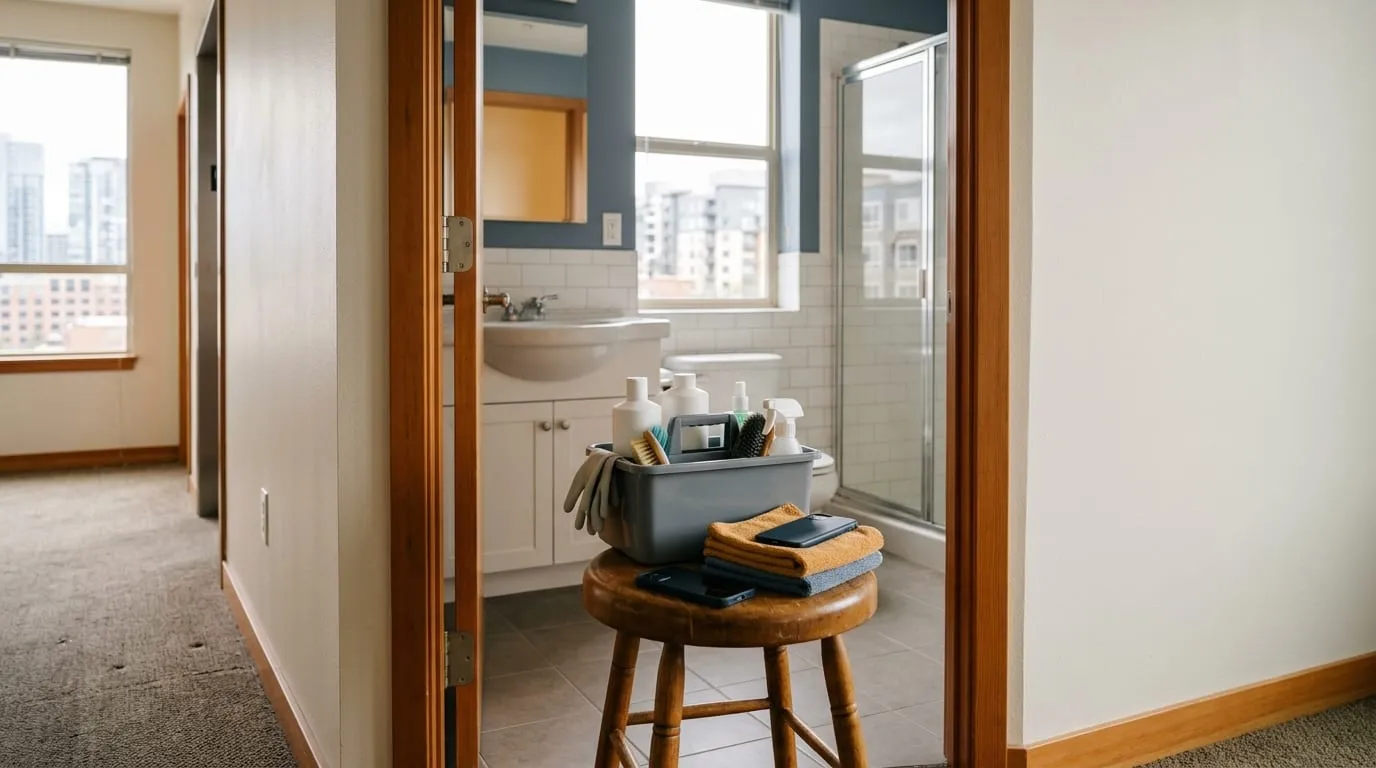
- Soap scum and mildew in grout, caulk, and the ceiling over the shower, common in Seattle bathrooms with weak exhaust fans.
- Window tracks packed with grit and dark condensation residue from winter.
- Pet hair worked into carpet and vents.
None of this requires a professional. It does require time, the right products, and patience with dwell times. If two or more of these apply and your time audit is tight, that combination is the strongest single argument for help.
Read the lease and the landlord’s checklist first
Before deciding who cleans, find three documents.
Your lease cleaning clause. It may say “professionally cleaned,” list specific tasks, or require receipts. A clause like that can make the decision for you, or at least tell you which parts need a receipt.
Your move-in checklist. It records what the unit looked like on day one. If the checklist says the oven was dirty when you arrived, that is the baseline; if it says clean, you are expected to return it clean. See how to document your apartment’s condition for using it at move-out.
Any move-out instructions from the landlord. Many property managers hand out a move-out checklist or cleaning guide. It is not law, but it tells you what they will look at. Give a copy to a cleaner if you hire one.
Nonrefundable cleaning fees
If you paid a nonrefundable cleaning fee at move-in, RCW 59.18.130(10) says you “shall not be charged for normal cleaning.” The City of Seattle’s move-in costs page says a landlord cannot charge for cleaning at the end if they charged for cleaning at the start. That does not cover removing your belongings or damage beyond ordinary wear, but it may mean an expensive professional clean is unnecessary. For more on how cleaning charges fit into the overall rules, see what landlords can and cannot deduct.
What professional move-out cleaners typically leave out
A move-out clean covers dirt, grease, dust, and residue. Most companies draw the line at repair, specialty, and hauling work. Typical exclusions:
- Carpet shampooing or steam extraction. Usually a separate carpet company.
- Patching and painting. Filling nail holes, touching up scuffs with paint, and repainting are repair work.
- Exterior windows, especially above the ground floor.
- Removing belongings, leftover furniture, or trash piles. The unit needs to be empty when cleaners arrive.
- Biohazards, heavy mold remediation, and pest cleanup, which call for specialists.
As one concrete example, Sweepless in Seattle, which publishes this guide, lists carpet shampooing, painting and patching, exterior windows, and removing belongings as outside its move-out cleans. Ask any company for its list in writing before you book, because the gaps are yours to cover.
How re-clean guarantees generally work
Many cleaning companies offer to return and fix missed spots. The terms vary, so read them closely. The useful questions are:
- What is the window? Guarantees usually require you or the landlord to report a problem within a set number of hours or days after the clean. If your inspection is a week later, a short window may not help.
- Who can report it? Some companies accept a report from the landlord directly; others only from you.
- What does it cover? Re-clean guarantees cover cleaning tasks in the original scope. They do not cover damage, repairs, carpet stains outside the scope, or items the landlord simply wants done differently.
- What does it not promise? No cleaning guarantee is a deposit guarantee. A company can re-clean a stovetop; it cannot control what a landlord deducts for other reasons.
For example, Sweepless in Seattle says that on move-out cleans, if the landlord flags the cleaning within 24 hours of the clean, it comes back free. Practically, that means scheduling the clean close to the inspection, and asking your landlord to walk the unit promptly, gives any guarantee the best chance of being useful.
The decision worksheet
Score each row honestly. Neither column is a verdict on its own; look at where most of your answers land, and give extra weight to time and condition.
| Factor | Points toward DIY | Points toward hiring help |
|---|---|---|
| Time in the empty unit before key return | One full uninterrupted day or more | Half a day or less, or shared with driving or work |
| People available | Two or more willing helpers | Just you, or helpers who leave early |
| Unit size | Studio or one-bedroom, one bathroom | Two or more bedrooms or bathrooms |
| Oven and range | Recently cleaned or light use | Years of baked-on buildup |
| Bathrooms | Surface soap scum only | Mildew in grout, caulk, or ceiling |
| Supplies on hand | You still have them unpacked | Already packed or moving long distance |
| Lease clause | No cleaning requirements beyond “clean” | Requires professional cleaning or receipts |
| Move-in checklist | Unit was recorded in average condition | Recorded as very clean, a high bar to match |
| Physical limits | Comfortable on ladders and kneeling | Injury, pregnancy, or mobility limits |
| Building access | Elevator or ground floor, easy parking | Walk-up, reserved elevator, scarce parking |
| Inspection timing | Flexible, you can fix things afterward | Tight, and you will already be gone |
If most answers sit on the left, a well-planned DIY clean is reasonable. If several of the high-stakes rows (time, oven, bathrooms, lease) land on the right, hiring at least part of the job is worth pricing out. Our guide to move-out cleaning cost in Seattle explains what drives a quote and how to compare them.
The middle path: a split job
You do not have to choose all or nothing. A common split:
- You do: closets, interior windows and sills, walls and switch plates, baseboards, and a final vacuum after the cleaner leaves if furniture was still being moved.
- The pros do: the oven, refrigerator, range hood, and bathrooms, which take the most time and draw the most inspection attention.
Ask whether a company prices individual appliances or rooms. If they only offer whole-unit packages, a split may not save money, but it can still save your moving week.
An illustrative scenario
Consider a hypothetical tenant leaving a two-bedroom, one-bath walk-up on Capitol Hill after four years. The movers are booked for Saturday morning; the lease ends Sunday night and the property manager inspects Monday. The tenant starts a new job across the state on Monday.
Running the worksheet: the empty-unit window is Saturday afternoon and Sunday, but Sunday includes the drive. The move-in checklist recorded the oven as clean, and four years of use left a heavy floor of carbon. The bathroom ceiling has mildew spots that appear every winter. The lease says only “clean condition.” Supplies are packed in the truck.
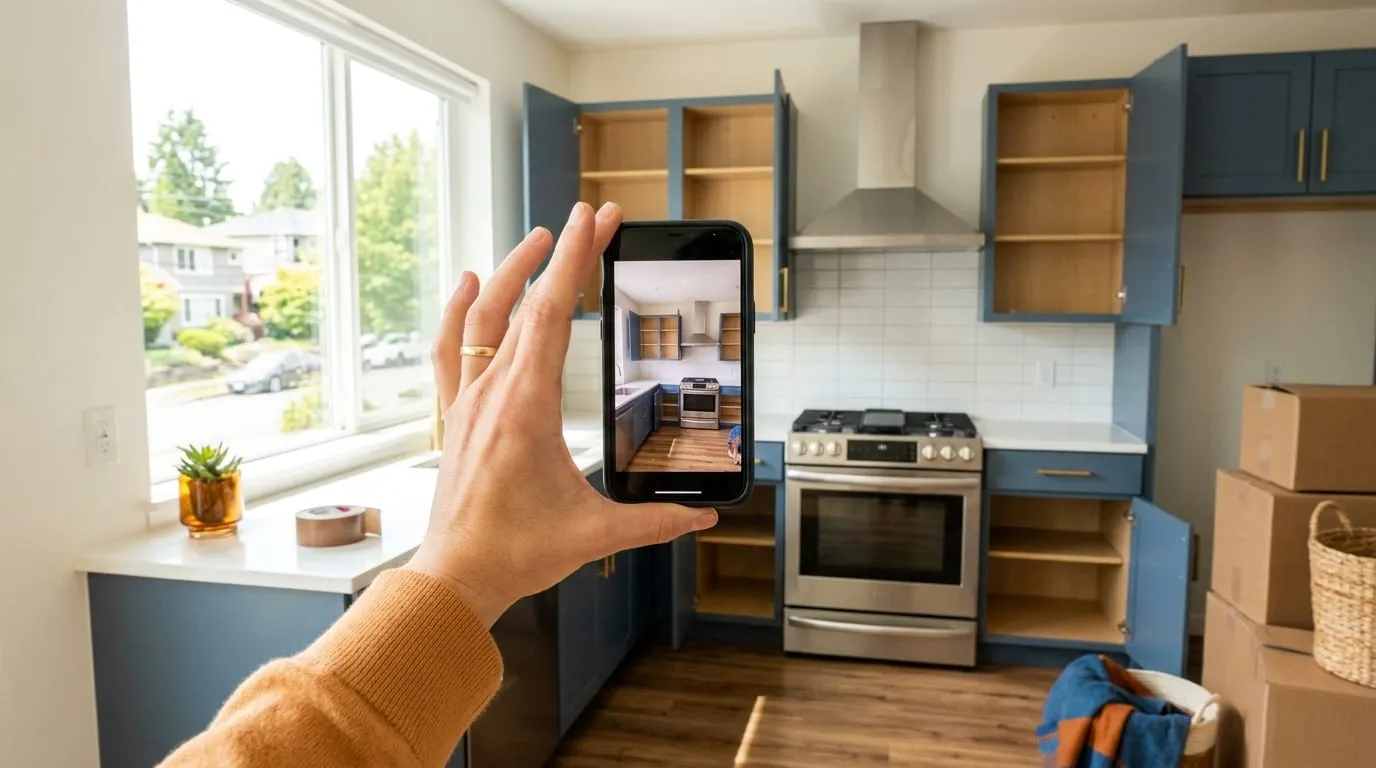
Four rows point toward help (time, oven, bathroom, supplies), so the tenant gets quotes for a move-out clean on Saturday afternoon and books one that excludes carpets and walls. The tenant spends Saturday morning walking the unit with the move-in checklist, taking photos and video, and later handles the closets and interior windows while the crew works. The hallway carpet shows an ordinary traffic path that matches the move-in note, so the tenant vacuums rather than renting an extractor. Before leaving, the tenant photographs every room again, saves the cleaning invoice, and emails the property manager a forwarding address.
None of this guarantees how the deposit comes out. It does mean cleanliness is documented, the oven and bathroom match the move-in record, and the tenant is not scrubbing an oven at midnight before a long drive across the state.
If you do it yourself, do it in this order
- Confirm power and water stay on through key day.
- Empty every room, cabinet, and closet completely.
- Start the oven product or self-clean cycle first, since it needs dwell time.
- Clean the refrigerator while the oven sits, then the rest of the kitchen.
- Spray bathroom surfaces and let the product work per its label while you do another room.
- Work every room top to bottom: fixtures, upper surfaces, walls, lower cabinets, baseboards.
- Floors last, then a final walk with the move-in checklist and a full set of photos.
The Seattle move-out checklist puts this clean in context with notice, utilities, and keys.
If you hire, book it like this
- Get quotes early, ideally when you give notice, because end-of-month weekends fill first.
- Send photos of the oven, refrigerator, and bathrooms, and say how many bedrooms and bathrooms, whether the unit will be empty, and whether there are stairs or a reserved elevator.
- Ask for the scope and exclusions in writing, plus the re-clean terms.
- Schedule the clean as close to the inspection as you can, and after the movers are fully gone.
- Do your own walkthrough and photos when the crew finishes, before they leave if possible.
If you would like a quote from the company that publishes this guide, Sweepless in Seattle offers move-out cleaning in Seattle, Bellevue, Kirkland, Redmond, and Renton, with flat, upfront quotes. Whoever you hire, compare at least two written scopes before you choose.
Common questions
Can my lease require me to hire a professional cleaner when I move out?
A lease can set cleaning terms, and many spell out expectations such as a professionally cleaned carpet. What a landlord may then deduct is still limited by Washington law, including the rule that carpet cleaning cannot be withheld from the deposit unless the landlord documents carpet wear beyond ordinary use. If a clause seems to conflict with the statute, the Renting in Seattle helpline or a tenant attorney can tell you how it applies to your situation.
Should I keep the receipt if I hire a move-out cleaner?
Yes. Keep the invoice, the list of tasks the company agreed to, and your own photos taken after they finish. If the landlord later raises cleanliness, you can show what was done and when, which is far stronger than saying the place was cleaned.
Can I split the job, doing some myself and hiring out the rest?
Often, yes, and it is a sensible middle path. Many renters handle closets, walls, and floors themselves and book help only for the oven, refrigerator, and bathrooms. Ask the cleaner whether they quote individual rooms or appliances, since some only offer whole-unit move-out packages.
Does hiring a cleaner mean I will get my full deposit back?
No one can promise that. A professional clean addresses dirt and residue, but deductions can also come from damage, missing items, unpaid rent, or anything beyond ordinary wear. A good clean plus careful documentation removes cleanliness as a reasonable point of dispute; it does not decide the rest.
Sources and references
- RCW 59.18.130 Duties of tenant , Washington State Legislature Primary source Accessed November 15, 2026
- RCW 59.18.260 Moneys paid as deposit or security for performance by tenant, written rental agreement required, checklist , Washington State Legislature Primary source Accessed November 15, 2026
- RCW 59.18.280 Moneys paid as deposit or security, statement of basis for retention, remedies , Washington State Legislature Primary source Accessed November 15, 2026
- Move in Costs , City of Seattle, Renting in Seattle Primary source Accessed November 15, 2026
- Return of Your Security Deposit , City of Seattle, Renting in Seattle Primary source Accessed November 15, 2026
- Cleaning and Maintenance , Carpet and Rug Institute Accessed November 15, 2026
See something out of date or wrong? Tell the editors. Read how we work in our editorial policy.