Moving in Seattle in Winter: Rain, Dark Evenings, and Month-End Moves
How to plan a Seattle winter move: protect floors and belongings from rain, work around short daylight, load a truck in the wet, and handle snow and pass crossings.
The short answer
Plan a Seattle winter move around rain and short days: start loading early, since the sun sets around 4:20 p.m. in December, lay runners and mats at every door, wrap mattresses and upholstery in plastic, keep boxes off wet ground, and check WSDOT pass reports and a backup date before any trip over the Cascades.
- In late December, Seattle gets roughly eight and a half hours between sunrise and sunset, so book the earliest start you can and finish the long carries before dark.
- November, December, and January are Sea-Tac's wettest months, each averaging more than 18 days with measurable rain, so assume it will rain on moving day and protect floors and soft goods accordingly.
- Snow is uncommon but possible: NOAA's normals put Sea-Tac at 1.7 to 2.2 inches a month from December through February. Keep a backup date or a flexible truck reservation.
- If you are leaving the region, check WSDOT's mountain pass reports the morning you drive. North Cascades Highway (SR 20) closes for the winter, and WSDOT says every driver should be able to install their own chains.
- Transfer stations and household hazardous waste sites close on Thanksgiving, Christmas Day, and New Year's Day, so plan disposal runs around the holidays.
A winter move in Seattle is mostly a rain move. Snow and ice happen some years, but the conditions you can count on are wet streets, muddy entries, and a sun that sets before most people leave work. This guide covers how to protect floors and belongings, how to schedule around short days, how to load a truck in the wet, what to do if it snows or you are crossing the Cascades, and how to time utilities and heat. It ends with a winter checklist you can print.
If you have not built your overall plan yet, start with the 30-day moving timeline and use this article to adjust it for November through February.
What Seattle winter actually looks like on moving day
The numbers below come from NOAA’s 1991-2020 climate normals for Seattle-Tacoma International Airport. They are long-term averages, not a forecast, but they tell you what to plan for.
| Month | Normal precipitation | Days with measurable rain | Normal low | Normal snowfall |
|---|---|---|---|---|
| November | 6.31 in | 18.4 | 40.9°F | 0.2 in |
| December | 5.72 in | 18.4 | 37.1°F | 1.7 in |
| January | 5.78 in | 18.7 | 37.7°F | 1.8 in |
| February | 3.76 in | 15.9 | 37.7°F | 2.2 in |
Two takeaways. First, on any given winter day, rain is close to a coin flip or better, so plan the whole move as if it will rain. Second, the normal lows sit just above freezing, which means frost and the occasional snow event are real possibilities even though the annual normal snowfall at Sea-Tac is only 6.3 inches. Hills, shaded streets, and higher neighborhoods can be icier than the airport.
Plan around the short days
The US Naval Observatory’s data for Seattle puts sunrise at 7:55 a.m. and sunset at 4:20 p.m. on December 21, 2026, with civil twilight ending about 4:56 p.m. At the end of November, sunset is also around 4:20 p.m. By late January it moves to about 5:09 p.m., and by the end of February to about 5:53 p.m.
That gives you roughly eight and a half hours of daylight in late December. Plan like this:
- Book the earliest start you can. Ask movers for the first crew of the day. If you rent a truck, pick it up the evening before or at opening, so loading starts in daylight.
- Do the long carries first. The heavy, awkward items that travel the farthest from the door (sofas, dressers, mattresses) should go out in the morning, when the crew is fresh and the stairs are lit.
- Light the path. Check that porch lights, stairwell lights, and hallway bulbs work at both addresses. Bring a couple of battery work lights or headlamps for the truck interior and any dim stairs.
- Schedule the unload with daylight in mind. If the new place is across town, you may load in daylight and unload in the dark. Decide in advance which rooms get unloaded first and keep the walkway clear.
- Push cleaning and walkthroughs earlier. A landlord walkthrough or move-out photo session goes better in daylight. Schedule the clean right after the truck leaves, and take your photos before sunset if you can. How to document your apartment’s condition explains what to capture.
Protect floors, entries, and belongings from rain
Wet grit is what scratches floors and leaves the dark tracks landlords notice at move-out. A few cheap layers prevent most of it.
Floors and entries
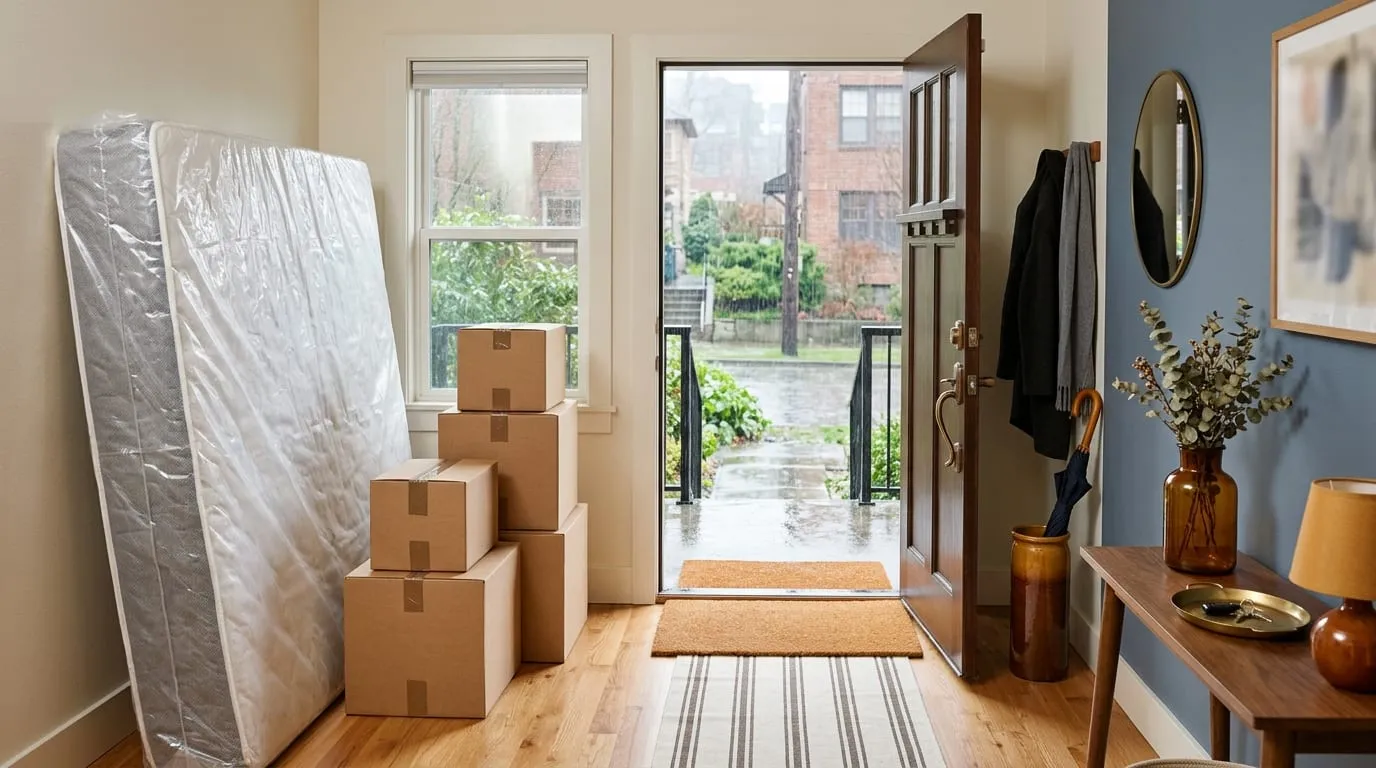
- Two mats per door. A coarse mat outside to scrape off grit and an absorbent one inside to catch water. Swap the inside mat for a dry one midday.
- Runners along the carry path. Canvas drop cloths, rubber-backed runners, or adhesive floor protection film from the door to each room. Tape loose edges so nobody trips with a box.
- Door jambs and banisters. Wrap corners with moving blankets or foam and painter’s tape. Wet hands and wet cardboard both slip.
- A towel station. A stack of old towels and a bucket by the entrance for wiping dolly wheels and shoes.
For deeper floor care in wet weather, the Seattle Cleaning Guide’s article on cleaning floors in a wet climate covers grit, moisture, and floor types.
Mattresses, upholstery, and electronics
- Bag every mattress and box spring in a plastic mattress bag and tape the open end. Do the same for upholstered chairs with stretch wrap or a fitted cover.
- Wrap electronics and lamps in a plastic bag inside their box or blanket. Cardboard alone does not keep out a soaking.
- Pack books and paper in plastic bins or double-bagged boxes. These suffer most from a wet bottom.
- Never set a box on wet pavement. Stage everything inside the doorway and carry straight to the truck.
Boxes in the rain
Cardboard loses strength when it gets wet. Tape the bottom seam twice, keep heavier items in smaller boxes, and do not stack wet boxes high. If a box gets soaked, repack it into a dry one at the destination rather than letting it sit.
Loading a truck in wet weather
- Park as close as the curb allows. On a Seattle block this usually means reserving space. SDOT’s Temporary No Parking Zone page says moving vans are an allowed purpose, that a moving truck needs a Restricted Area truck permit, and that signs and the public notice should go up 72 hours ahead. The Seattle move-out checklist walks through the permit steps. Note that SDOT’s in-person kiosk is open weekdays only, except holidays, which matters in late December.
- Lay a tarp or cardboard on the ramp and truck floor. Ramps get slick fast. Some crews put a rubber mat at the top of the ramp.
- Load soft goods last, toward the door, only if they are fully wrapped. Mattresses and upholstery should not sit against the cold, damp truck wall without a cover.
- Close the truck door between trips during heavy rain.
- Wipe down furniture with a dry towel before it comes inside the new place.
- Unpack anything damp within a day. Bedding, clothes, and cardboard that stay damp in a closed box can start to smell musty.
Snow and ice: build in a contingency
Seattle does not get much snow on average, but when it does, steep residential streets can be hard to drive and harder to carry boxes on. WSDOT’s snow and ice plan says the agency prioritizes highways by traffic and access, with interstate corridors like I-5 at the top. City side streets are not WSDOT’s job, and hills you live on may be among the last places cleared.
Your contingency plan:
- Ask about rescheduling when you book. Find out the mover’s or rental company’s weather policy and fees before you sign.
- Pick a backup date and check that your lease end, the new lease start, and any parking permit dates leave room for it.
- Keep ice melt and a shovel at the old place until the truck leaves. Clear the walkway and ramp landing first.
- Watch the forecast from three days out. If snow or freezing rain is likely, confirm or move the date the day before, not at 7 a.m. on moving day.
Moving out of the region: mountain passes in winter
If you are heading east over the Cascades, check WSDOT’s mountain pass reports the morning you leave and again before you climb. Conditions and requirements change through the day.
- Know which passes close. WSDOT’s historic records show North Cascades Highway (SR 20) closing for the season (December 4 in 2025, November 18 in 2024), and Chinook and Cayuse passes closing in late October or November. Do not plan a winter route over them.
- Carry chains and know how to use them. WSDOT’s snow and ice guidance tells drivers to have appropriate tires for winter and to pack chains. Its chain installation page notes that permitted installers on I-90 are not required to respond, “so all drivers should be able to install their own tire chains.” Practice once in a dry driveway.
- Check your truck’s rules. WSDOT lists separate chain installation rates for vehicles over 10,000 pounds gross vehicle weight, a reminder that pass requirements can be posted by vehicle type. Read your rental agreement for any rules on chains and ask the counter what applies to your truck size.
- Leave early and keep options open. WSDOT’s own advice is to expect delays, leave early, or take an alternate route, and that no appointment is worth the risk.
Month-end moves in winter
Many leases run to the last day of a month, so moving days cluster at month end, often on weekends. In winter that cluster runs into Thanksgiving, Christmas, and New Year’s. We have not found reliable Seattle data on how much demand rises, so treat this as a scheduling problem rather than a price claim:
- Book early if your date is the last weekend of November or December.
- Ask for a weekday quote too. If your lease allows overlap, a midweek date may be easier to book.
- Watch holiday closures. Seattle Public Utilities lists its North and South transfer stations as closed on Thanksgiving, Christmas Day, and New Year’s Day, and its household hazardous waste facilities close on those days as well. On the first Wednesday of each month, the transfer stations open at 10 a.m. instead of 8 a.m. The disposal and donation guide explains what goes where.
- Bulky item pickup in the rain. SPU’s Special Item Pickup asks that items be covered on rainy days. Renters in apartment buildings cannot book it themselves; the property manager or owner has to.
Utilities and heat: time the handoff
Winter is when a gap in power or heat matters most.
- Electricity. Seattle City Light lets you start or stop service online or by phone at (206) 684-3000, and asks for the date you want service started or stopped. It also notes that many property managers handle connecting and disconnecting service for tenants, so ask yours first. The City of Seattle’s renter guide says renters can open City Light accounts in their own names and are responsible for telling City Light when they move out.
- Water, sewer, garbage. The City’s renter guide says new tenants cannot open Seattle Public Utilities accounts in their own names; the landlord holds them.
- Gas heat. If your new place uses gas, contact the gas utility well before the move. We have not verified a specific notice period, so ask when you call.
- Overlap by a day. Set the start date at the new place on or before moving day, and the stop date at the old place for the day after you hand back keys. That keeps the lights and heat on for the final clean and walkthrough.
- Leave the old place heated. Do not shut the thermostat off completely in a cold snap. Set it low and leave it running until you return keys.
An illustrative winter move
Consider a hypothetical renter in a third-floor walk-up in Queen Anne moving to a ground-floor unit in Columbia City on December 31, a Thursday.
- Early November: She books a two-person crew for the first slot of the day and asks about the weather policy. The mover offers January 2 as a backup.
- Mid-December: She reserves curb space at both addresses and sets City Light to start at the new unit December 30 and stop at the old one January 1. She takes leftover paint to the South household hazardous waste facility on a Saturday, avoiding the holiday closure.
- December 30: She lays runners from the stairwell to each room, bags two mattresses, and stacks towels by the door. The forecast calls for rain, not snow, so the date holds.
- December 31: The crew starts at 8 a.m. USNO data puts sunrise that day at about 7:58 a.m. and sunset at about 4:28 p.m. The heavy furniture comes down the stairs first. The truck is loaded by early afternoon and unloaded at the new place before full dark, with a work light for the last few boxes.
- Afternoon: Her move-out clean happens while the light lasts, and she photographs each room before 4:30 p.m.
Nothing in this plan depends on good weather. It depends on starting early and having a backup.
Winter moving checklist
| When | Task | Done |
|---|---|---|
| 4 to 6 weeks out | Book movers or truck; ask for the first slot and the weather and rescheduling policy | [ ] |
| 4 to 6 weeks out | Choose a backup date that fits both leases | [ ] |
| 3 to 4 weeks out | Plan disposal and donation runs around holiday closures | [ ] |
| 2 weeks out | Reserve curb space and a truck permit with SDOT (kiosk closed weekends and holidays) | [ ] |
| 2 weeks out | Schedule electricity and gas start and stop dates with a one-day overlap | [ ] |
| 1 week out | Buy mattress bags, stretch wrap, runners, painter’s tape, and two mats per door | [ ] |
| 1 week out | Check porch and stair lights at both addresses; get work lights or headlamps | [ ] |
| 3 days out | Check the forecast; confirm or move the date | [ ] |
| Leaving the region | Check WSDOT pass reports, pack chains, practice fitting them | [ ] |
| Day before | Lay runners, set up mats and the towel station, bag mattresses | [ ] |
| Moving day | Start at first light, carry heavy items first, keep boxes off wet ground | [ ] |
| Moving day | Clean and photograph the old unit before dark; leave heat on low | [ ] |
| Day after | Unpack anything damp; dry towels, blankets, and wet boxes | [ ] |
For the cleaning itself, the Seattle apartment move-out cleaning checklist lists the landlord-standard tasks, and the move-in cleaning checklist covers what to do on arrival, including wiping up whatever the rain tracked in.
Common questions
Is it cheaper to move in Seattle in winter?
It can be, but we have not found published Seattle data that proves it. Movers and truck rental companies set their own prices, so the honest approach is to request quotes for two or three dates, including a midweek, mid-month option, and compare them side by side.
Should I cancel my move if it snows?
Decide the day before, not at the curb. If your street is steep, unplowed, or icy, a loaded truck on a Seattle hill is a real hazard, so call the mover or rental office early about rescheduling. That is why a backup date and a flexible reservation are worth asking for when you book.
Will movers carry things in the rain?
Most moves go ahead in ordinary rain, since rain is the normal winter condition here. Ask your mover how they protect floors, mattresses, and upholstery, and whether they bring floor runners, door jamb protection, and plastic covers or expect you to supply them.
Do I need chains to drive a rental truck over Snoqualmie Pass?
It depends on the conditions posted that day. Check WSDOT's pass report before you leave, read your rental agreement for any rule about chains, and practice fitting chains before the trip. WSDOT warns that permitted chain installers are not required to respond, so you should be able to install your own.
Sources and references
- Monthly climate normals 1991-2020, Seattle-Tacoma International Airport (USW00024233) , NOAA National Centers for Environmental Information Primary source Accessed November 15, 2026
- Annual climate normals 1991-2020, Seattle-Tacoma International Airport , NOAA National Centers for Environmental Information Primary source Accessed November 15, 2026
- Sun and Moon Data for One Day (Seattle, December 21, 2026) , US Naval Observatory Primary source Accessed November 15, 2026
- Snow and ice plan , Washington State Department of Transportation Primary source Accessed November 15, 2026
- Tire chain installation , Washington State Department of Transportation Primary source Accessed November 15, 2026
- Mountain pass closure and opening dates , Washington State Department of Transportation Primary source Accessed November 15, 2026
- Mountain pass reports , Washington State Department of Transportation Primary source Accessed November 15, 2026
- Temporary No Parking Zone Reservation , Seattle Department of Transportation Primary source Accessed November 15, 2026
- Transfer Stations (Dumps/Landfills) , Seattle Public Utilities Primary source Accessed November 15, 2026
- Where to Dispose of Household Hazardous Waste , Seattle Public Utilities Primary source Accessed November 15, 2026
- Special Item Pickup , Seattle Public Utilities Primary source Accessed November 15, 2026
- Start or Stop Electricity Service , Seattle City Light Primary source Accessed November 15, 2026
- Utilities (Renting in Seattle) , City of Seattle Primary source Accessed November 15, 2026
See something out of date or wrong? Tell the editors. Read how we work in our editorial policy.