Disposal and Donation Guide for a Seattle Move
Where to take furniture, mattresses, electronics, appliances, paint, chemicals, batteries, and clothes when you move in Seattle, with SPU fees and timing.
The short answer
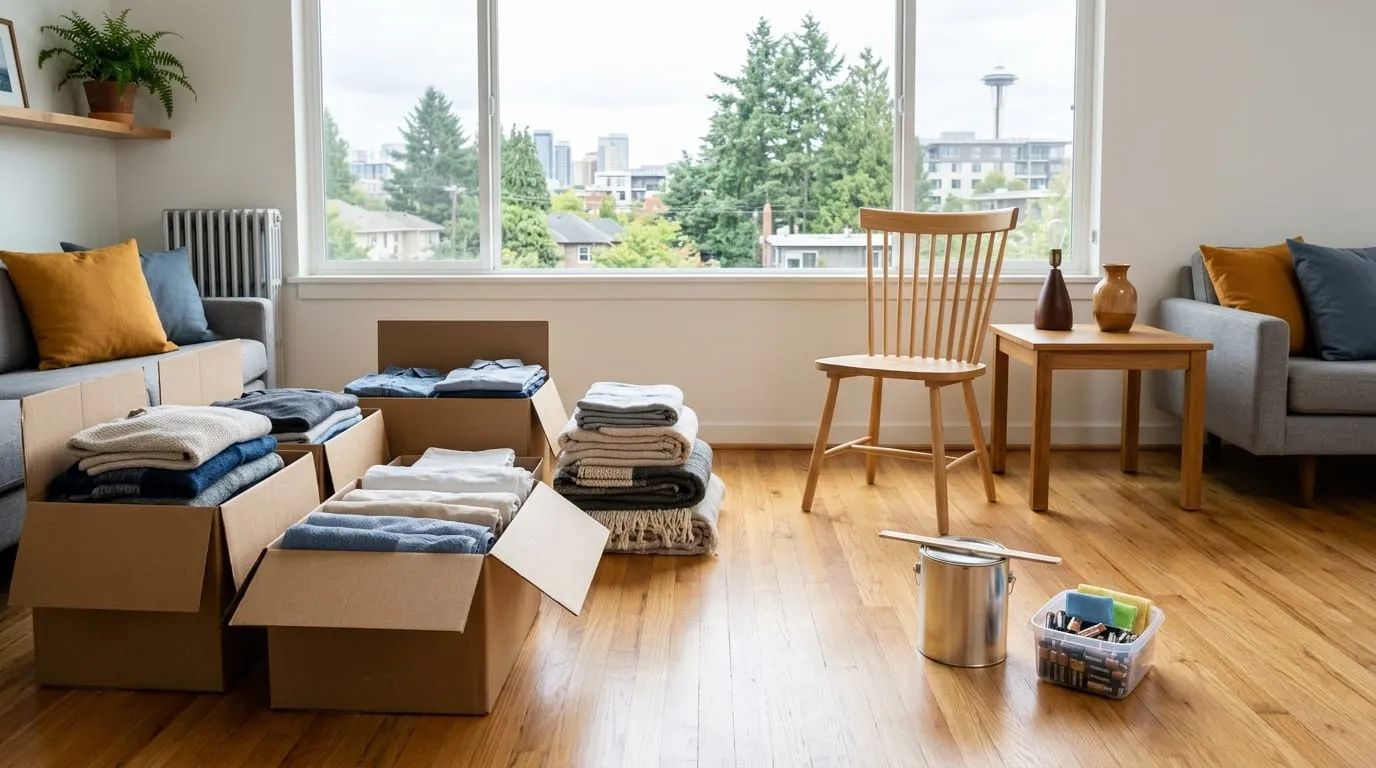
Sort everything into donate, special pickup, transfer station, and hazardous waste: donate clean, dry goods; book Seattle Public Utilities' Special Item Pickup or haul bulky items to the North or South transfer station; take electronics to E-Cycle Washington; and take oil paint, chemicals, and batteries to a free household hazardous waste facility, which is separate from the transfer stations.
- Transfer stations and household hazardous waste facilities are different places. SPU's transfer stations do not accept household chemicals, oil paint, or electronics like TVs and monitors.
- Seattle bans batteries and covered electronics from the garbage. Use E-Cycle Washington, a hazardous waste site, or SPU's Special Item Pickup.
- As of November 15, 2026, SPU lists Special Item Pickup at $31 per large item and $39.25 for refrigerators and freezers made before 2005; renters must ask the landlord to book it.
- Do not donate anything wet, mildewed, or soiled with hazardous materials, which is SPU's own guidance.
- Start sorting three to four weeks before moving day so donation pickups, special item dates, and hazardous waste trips fit before the truck arrives.
The fastest way to clear out before a Seattle move is to sort every unwanted item into one of four streams: donate or give away, Seattle Public Utilities (SPU) Special Item Pickup, a transfer station, or a household hazardous waste facility. Each stream has its own rules, days, and fees, and the two disposal sites people most often confuse (transfer stations and hazardous waste facilities) do not accept each other’s materials.
This guide expands the short sorting step in the Seattle move-out checklist. It assumes you live in Seattle; notes for the rest of King County are near the end. Fees below are quoted from SPU’s pages as they appeared on November 15, 2026. Check the pages again before you go, because rates change.
Start with the decision table
Find the item, then follow the row. “Special Item Pickup” means SPU’s curbside service for Seattle utility customers.
| Item | Donate or reuse? | Seattle disposal route | Notes |
|---|---|---|---|
| Furniture (sofas, dressers, tables) | Yes, if clean, dry, and sound | Special Item Pickup ($31 per item) or a transfer station | SPU lists furniture, dressers, cabinets, tables, chairs, and sofas as large items |
| Mattresses and box springs | Ask the charity first | Special Item Pickup ($31 per item) or a transfer station | Do not donate anything wet or mildewed |
| TVs, monitors, computers, laptops, tablets | Working items can be resold or given away | E-Cycle Washington drop-off (free), or Special Item Pickup | Banned from Seattle garbage; transfer stations do not take TVs or monitors |
| Keyboards, mice, printers | Yes, if working | Retail take-back or the 1-800-RECYCLE database | Not covered by E-Cycle Washington, per Ecology |
| Refrigerators and freezers made before 2005 | Rarely | Special Item Pickup ($39.25 per item) | SPU says these contain CFCs |
| Other large appliances (washer, dryer, stove, dishwasher, newer fridge) | Yes, if working | Special Item Pickup ($31 per item) or a transfer station ($34 per appliance) | Transfer station fridges must be empty with doors removed |
| Latex paint | Yes, through PaintCare reuse sites | PaintCare drop-off, or dry it and put the can in the garbage with the lid off | Not accepted at hazardous waste facilities |
| Oil-based paint, stain, varnish, thinner | Offer leftovers to someone who can use them | Household hazardous waste facility or PaintCare | Transfer stations do not accept oil paint |
| Cleaning chemicals with CAUTION, WARNING, DANGER, or POISON on the label | Give unopened products away | Household hazardous waste facility | Containers 5 gallons or less; never combine products |
| Household batteries | No | Hazardous waste facility, Special Item Pickup, or the Special Item Box | Banned from Seattle garbage; tape the ends |
| Clothing, shoes, linens | Yes, in almost any condition | Threadcycle partners listed by SPU | Never in the recycling bin; nothing wet or mildewed |
Donate first, and donate well
Donation keeps the most out of the truck and the landfill, but only if what you give is usable.
What SPU asks
SPU’s donation page says its Threadcycle partners accept clothes, shoes, and linens even when torn or badly worn, plus single socks, gloves, and other orphan items. Its one firm rule: do not give items that are wet, mildewed, or soiled with hazardous materials. It also asks that clothes and household fabrics stay out of the recycling bin.
That rule matters in Seattle. A box of linens from a damp basement storage unit, or a sofa that sat on a covered porch through a rainy season, may smell or carry mildew you stop noticing. If it smells musty, it is a disposal item, not a donation.
Donation etiquette
- Call or check online before you load the car. Charities set their own rules on furniture, mattresses, cribs, and small appliances.
- Clean and dry everything. Wipe furniture, wash and fully dry textiles, and test anything that plugs in.
- Bag small parts. Hardware for a disassembled table goes in a labeled bag taped to the piece.
- Do not leave items outside a closed donation site. Rain ruins them, and they become someone else’s disposal problem.
- Offer leftovers locally. SPU points to Buy Nothing groups, swaps, and tool libraries as other ways to pass things on. That is often the best route for half-used cleaning products, plants, and moving boxes.
SPU Special Item Pickup
Special Item Pickup is SPU’s curbside collection for things that do not belong in carts. Items collected are recycled where possible.
What it costs (as listed November 15, 2026)
| Service | SPU listed price | Limits |
|---|---|---|
| Large furniture, large electronics, appliances | $31 per item | Up to 300 lb, 8 ft tall, or 4 ft in diameter |
| Refrigerators and freezers with CFCs (made before 2005) | $39.25 per item | Remove latched doors or secure them shut |
| Household batteries | One free pickup per year, then $5 | Two 1-gallon bags; no car, e-bike, or e-scooter batteries |
| Special Item Box (small electronics, bulbs, small propane canisters, batteries) | One free per year, then $20 | One 2 x 2 x 2 ft box, 60 lb max |
| Foam blocks | Free | Two 32-gallon bags; no packing peanuts |
SPU says charges appear on the combined utility bill, and the free battery and box pickups must be ordered by phone at (206) 684-3000.
The renter catch
SPU says apartment residents and renters cannot schedule a pickup, because the property manager or owner is responsible for the utility bill. If you rent, ask your landlord early. They may schedule it, add it to your final charges by agreement, or tell you to use another route. Get any arrangement in writing.
Setting items out
For single-family homes, SPU collects on your next regular garbage day after the pickup is scheduled. Items must be out by 7 a.m., on a flat surface with no stairs, and easy to reach from the street. SPU also asks that items be covered on rainy days and that you not leave anything outside without a confirmed pickup. In multifamily buildings, agree on a spot the driver can reach without keys or fobs.
Transfer stations: bulky trash and appliances
SPU runs two transfer stations for Seattle residents:
- North: 1350 N 34th St
- South: 130 S Kenyon St
SPU lists hours of 8 a.m. to 5:30 p.m. daily, except the first Wednesday of the month, when they open at 10 a.m. Both are closed on Thanksgiving, Christmas Day, and New Year’s Day, and the North station also closes on the 4th of July.
Rates as of April 1, 2026
- Garbage: $37 minimum per trip, which SPU says covers up to 420 pounds, then $174 per ton.
- Clean yard waste and clean wood: $25 minimum per trip.
- Appliances: $34 per appliance, limit two per load; refrigerators must be empty with doors removed.
- Recyclables only: no charge.
- Unsecured loads: an extra fee. Tie down and tarp everything.
Separating clean wood and yard waste from garbage before you arrive gets the lower rate. Payment is cash, check, Visa, or MasterCard.
What transfer stations do not take
SPU’s list of refused materials includes hazardous waste, oil paint and its containers, household chemicals, electronics such as TVs and CRT monitors, propane and fuel tanks, fire extinguishers, asbestos, and anything over 8 feet long and over 200 pounds. Bring those to the right place instead, or you will be turned around at the scale.
Household hazardous waste: a separate trip
SPU states plainly that its household hazardous waste facilities are separate from the transfer stations, which do not accept household hazardous waste. The facilities are free for all King County residents, with no appointment:
| Facility | Address | Days and hours |
|---|---|---|
| North Seattle | 12550 Stone Ave N | Sunday to Tuesday, 9 a.m. to 5 p.m. |
| South Seattle | 8100 2nd Ave S | Thursday to Saturday, 9 a.m. to 5 p.m. |
| Factoria (Bellevue) | 13800 SE 32nd St | Tuesday to Friday 8 a.m. to 4 p.m.; Saturday and Sunday 9 a.m. to 5 p.m. |
| Algona | 35101 West Valley Hwy S | Monday, Tuesday, Thursday, Friday 8 a.m. to 4 p.m.; Saturday and Sunday 9 a.m. to 5 p.m. |
All four close on Thanksgiving, Christmas Day, and New Year’s Day; the two Seattle sites also close July 4. King County’s traveling Wastemobile runs February through October.
Cleaning chemicals
King County says to bring cleaners labeled CAUTION, WARNING, DANGER, or POISON to a hazardous waste site, in containers of 5 gallons or less. Keep each product in its original, labeled container, packed upright in a box. Never pour leftovers together to save space; King County notes that bleach reacts with ammonia to form a toxic gas. If you are cleaning the unit yourself, buy only what the job needs; the Seattle Cleaning Guide covers which cleaners to use and what never to mix.
Paint
- Latex, water-based, or acrylic: King County says hazardous waste sites do not accept it. Take it to a PaintCare drop-off site, which PaintCare says is free, or dry it out: under an inch in the can can air-dry; more than that can be solidified with cat litter or paint hardener. Then put the can in the garbage with the lid off.
- Oil-based paint: accepted at hazardous waste sites and at PaintCare sites.
Batteries
SPU’s Director’s Rule SW-404 bans batteries from Seattle garbage and recycling. King County’s sites accept alkaline, button, rechargeable, laptop, and car batteries, with limits (for example, five lead-acid auto batteries per visit and 50 pounds of other batteries). Tape the ends of lithium and rechargeable batteries. Electric vehicle batteries are not accepted.
Fluorescent bulbs
King County lists fluorescent bulbs and tubes as accepted. SPU will not collect broken ones curbside.
Electronics and appliances with refrigerant
Electronics. SPU’s ban also covers electronics included in Washington’s electronics recycling law. The Department of Ecology’s E-Cycle Washington program recycles TVs, computers, monitors, laptops, tablets, e-readers, and portable DVD players for free at authorized drop-off sites. Ecology says keyboards, mice, and printers are not covered and points to retailer take-back and the 1-800-RECYCLE database. Wipe your data before you drop off a computer or phone.
Refrigerators, freezers, and window air conditioners. EPA rules require that refrigerant be recovered before final disposal, and the final processor is responsible for making sure that happens. You do not need to drain anything yourself. Use SPU’s Special Item Pickup, which has a separate rate for older CFC units, or the transfer station’s appliance rate. Empty, defrost, and dry the unit a day ahead, and remove or secure latched doors.
Outside Seattle
King County’s transfer stations serve its 37-city and unincorporated service area, which does not include Seattle or Milton, so a Seattle household cannot use them and a Bellevue household cannot use SPU’s stations. Hazardous waste sites are different: they are open to all King County residents. King County also says new solid waste disposal fees take effect January 1, 2027, so check rates if your move falls after that date.
Fit it into your move timeline
- Three to four weeks out: Walk each room and tag items by stream. Ask your landlord about Special Item Pickup. Book any charity pickups.
- Two to three weeks out: Do the hazardous waste run on the right day for the facility you choose. Drop electronics at an E-Cycle site.
- Two weeks out: Confirm Special Item Pickup dates. Let latex paint dry.
- Final week: Transfer station run for broken furniture and bulky trash. Give away leftover food, plants, and cleaning supplies.
- After the truck leaves: Check closets, cabinets, the balcony, and the storage unit for stragglers before the cleaning starts.
The 30-day moving timeline shows where these slot into the rest of the move. If you are moving between November and February, the winter moving guide covers holiday closures and rain.
An illustrative example
Consider a hypothetical renter leaving a one-bedroom in Fremont with a worn sofa, a mattress stored in a damp basement unit, an old laptop, two bags of clothes, three half-used cans of latex paint, a can of oil-based stain, and a crate of cleaning products.
- Clothes: dry and clean, so they go to a Threadcycle partner.
- Mattress: it smells musty, so it is not donated. The landlord agrees to book Special Item Pickup together with the sofa, listed at $31 each, and the charge is agreed in writing.
- Laptop: data wiped, dropped at an E-Cycle Washington location for free.
- Latex paint: one can is nearly empty and dries out in a few days; the other two go to a PaintCare drop-off.
- Stain and cleaners: packed upright, each in its labeled container, and driven to the North hazardous waste facility on a Sunday.
- Leftovers: an unopened bottle of all-purpose cleaner goes to a neighbor through a Buy Nothing group.
The basement unit is empty a week before moving day, and nothing is left for the landlord to haul away.
Leave nothing behind
Anything you leave in a rental can turn into a removal charge. Washington’s deposit rules and what landlords can charge are covered in what landlords can and cannot deduct. Once the unit is empty, move on to the Seattle apartment move-out cleaning checklist.
Common questions
Can I just leave furniture by the dumpster when I move out?
No. SPU asks people not to leave items outside without a confirmed Special Item Pickup, and anything you leave in or around a rental can become a removal charge on your deposit statement. Ask your property manager to schedule a pickup, haul it to a transfer station, or donate it.
Can I throw old batteries or a broken laptop in the garbage in Seattle?
No. SPU's Director's Rule SW-404 bans batteries and covered electronic products from garbage and recycling containers. If they show up in your cart, SPU says you will get a tag asking you to remove them. Use a hazardous waste site for batteries and an E-Cycle Washington location for electronics.
Is it free to drop off hazardous waste?
Yes, for King County residents. SPU says its North and South household hazardous waste facilities are free for all King County residents and need no appointment. King County's product pages say containers must be 5 gallons or less.
Do I live in Seattle for disposal purposes if I am in Bellevue or Renton?
No. Seattle's transfer stations serve Seattle residents. King County's transfer stations serve its 37-city and unincorporated service area, which does not include Seattle. Hazardous waste sites, though, are open to all King County residents, including the Factoria site in Bellevue.
Sources and references
- Special Item Pickup , Seattle Public Utilities Primary source Accessed November 15, 2026
- Transfer Stations (Dumps/Landfills) , Seattle Public Utilities Primary source Accessed November 15, 2026
- Transfer Station Rates , Seattle Public Utilities Primary source Accessed November 15, 2026
- Where to Dispose of Household Hazardous Waste , Seattle Public Utilities Primary source Accessed November 15, 2026
- Hazardous Waste Items , Seattle Public Utilities Primary source Accessed November 15, 2026
- Ban on Batteries and Electronics in Garbage , Seattle Public Utilities Primary source Accessed November 15, 2026
- Donate, Share, Resell, and Buy Used , Seattle Public Utilities Primary source Accessed November 15, 2026
- Where Does It Go? Tool , Seattle Public Utilities Primary source Accessed November 15, 2026
- Disposal facilities (household hazardous waste) , King County Primary source Accessed November 15, 2026
- Hazardous household products list , King County Primary source Accessed November 15, 2026
- Battery disposal , King County Primary source Accessed November 15, 2026
- All purpose cleaner disposal , King County Primary source Accessed November 15, 2026
- Paint disposal: latex, water-based, or acrylic , King County Primary source Accessed November 15, 2026
- Solid waste facilities , King County Primary source Accessed November 15, 2026
- Electronics: E-Cycle Washington , Washington State Department of Ecology Primary source Accessed November 15, 2026
- Washington paint recycling and drop-off locations , PaintCare Accessed November 15, 2026
- Stationary Refrigeration Safe Disposal Requirements , US Environmental Protection Agency Primary source Accessed November 15, 2026
See something out of date or wrong? Tell the editors. Read how we work in our editorial policy.