Mold in a Washington Rental: Who Is Responsible
Who handles mold in a Washington rental: landlord repair duties, tenant duties, how to report it in writing, and what RCW 59.18 says happens next.
The short answer
In Washington, the landlord is responsible for the building problems that usually cause mold (leaks, failed weatherproofing, broken plumbing, heating or ventilation) under RCW 59.18.060, while the tenant must keep the unit clean and sanitary and use the fixtures properly under RCW 59.18.130. The state Department of Health sums it up: fixing leaks is generally the landlord's job and reducing condensation is generally the renter's. Report the moisture problem to your landlord in writing, which starts the repair clock in RCW 59.18.070.
- Washington's landlord-tenant act does not list mold as a repair item. It makes landlords fix what causes it: leaks, roofs and walls, plumbing, heating, and keeping the unit reasonably weathertight (RCW 59.18.060).
- Landlords must give new tenants Department of Health approved information about indoor mold at lease signing, or post it in a visible place on the property (RCW 59.18.060).
- Tenants must keep their unit as clean and sanitary as conditions permit and properly use heating and plumbing fixtures (RCW 59.18.130). The Department of Health adds that renters should run heat and ventilation to limit condensation.
- A written repair notice starts the landlord's deadline: 24 hours, 72 hours, or 10 days depending on the problem (RCW 59.18.070). The City of Seattle says state law requires repair requests in writing even if you call first.
- EPA and the Department of Health both say a moldy area under about 10 square feet is usually a do-it-yourself cleanup, but the water source still has to be fixed or it comes back.
Mold in a Washington rental is usually a shared problem with a clear dividing line. The landlord must fix the building defects that let water in or keep it trapped, such as a leaking roof, a failed window seal, a broken bathroom fan, or a slow plumbing leak. The tenant must keep the unit reasonably clean, use the heat and fixtures properly, and report problems promptly. Below: what the statute says on each side, how to request repairs in writing, what happens if repairs stall, and how to document it.
This is general information drawn from the statute and agency pages listed in the sources, not legal advice for your situation.
What Washington law says landlords must do
Washington’s Residential Landlord-Tenant Act is chapter 59.18 RCW. The landlord duties are in RCW 59.18.060, which opens with a broad rule: the landlord “will at all times during the tenancy keep the premises fit for human habitation.” The section then lists specific duties. The word “mold” appears only in a disclosure duty, but several repair duties cover the usual causes of mold.
The repair duties that matter for mold
Under RCW 59.18.060, the landlord must, among other things:
- Comply with codes that govern the building’s maintenance or operation, where a condition “endangers or impairs the health or safety of the tenant” (subsection 1).
- Keep structural components in reasonably good repair, including “the roofs, floors, walls, chimneys, fireplaces, foundations” (subsection 2).
- Make repairs needed to keep the unit in as good condition as it should have been at the start of the tenancy, except conditions attributable to “wear resulting from ordinary use of the premises” (subsection 5).
- Maintain electrical, plumbing, heating, and other facilities and appliances they supply “in reasonably good working order” (subsection 8). A bathroom exhaust fan or a furnace the landlord supplied falls here.
- Keep the unit “in reasonably weathertight condition” (subsection 9). Leaky windows, failed flashing, and roof leaks are weathertightness problems.
The mold information duty
RCW 59.18.060 also requires landlords to “provide tenants with information provided or approved by the department of health about the health hazards associated with exposure to indoor mold.” The statute says the information may be given to each tenant in writing or “posted in a visible, public location at the dwelling unit property,” must explain how tenants can control mold growth, and must be given to new tenants “at the time the lease or rental agreement is signed.”
The next subsection limits the consequences: landlords and their agents are “immune from civil liability” for failing to provide that information except where they “knowingly and intentionally” do not comply. The Department of Health’s renter and landlord page lists its own Mold Questions and Answers and EPA’s Brief Guide to Mold, Moisture, and Your Home as materials that can fulfill the requirement.
Where the landlord’s duty stops
The final paragraph of RCW 59.18.060 says no repair duty applies, and no tenant remedy is available, “where the defective condition complained of was caused by the conduct of such tenant,” their family, guests, or others under their control, or “where a tenant unreasonably fails to allow the landlord access to the property for purposes of repair.”
What tenants must do
Tenant duties are in RCW 59.18.130. The parts that matter for moisture and mold:
- Keep the part of the premises you occupy “as clean and sanitary as the conditions of the premises permit” (subsection 1).
- “Properly use and operate all electrical, gas, heating, plumbing and other fixtures and appliances supplied by the landlord” (subsection 3).
- Not “intentionally or negligently” damage the structure or the landlord’s fixtures and appliances (subsection 4).
- At move-out, restore the unit to its initial condition except for wear from ordinary use “or conditions caused by failure of the landlord to comply with his or her obligations under this chapter” (subsection 10).
The statute does not use the word “ventilation.” That guidance comes from the Washington State Department of Health, which says renters “need to operate the heating and ventilation systems to reduce water condensation” and “need to notify landlords promptly, in writing, of any water leaks or moisture buildup due to building problems.”
The Department of Health’s main mold page puts the split in one sentence: “Generally, fixing leaks is the landlord’s responsibility and reducing condensation is the renter’s responsibility.” EPA tells renters to report all plumbing leaks and moisture problems immediately to the owner or manager.
Who does what: a working table
This table combines the statute and the agency guidance. It is a starting point for a conversation with your landlord, not a ruling on any particular case.
| Situation | Usually the landlord’s job | Usually the tenant’s job | Where it comes from |
|---|---|---|---|
| Roof, siding, or window leak | Find and fix the leak; repair water-damaged walls | Report it in writing promptly; move belongings away from the water | RCW 59.18.060 (structural, weathertight); DOH |
| Plumbing leak under a sink or in a wall | Repair the plumbing and damaged materials | Report it; do not keep using a fixture you know is leaking into the wall | RCW 59.18.060 (plumbing); RCW 59.18.130 (proper use) |
| Bathroom or kitchen exhaust fan broken | Repair or replace the fan they supplied | Report it; run it during and after showers once working | RCW 59.18.060 (facilities in working order); DOH |
| Heat not working in winter | Restore heat (a 24-hour item under RCW 59.18.070) | Report it in writing | RCW 59.18.060, .070 |
| Condensation on windows, small spots on sills | Fix failed seals or a broken fan if that is the cause | Wipe condensation, run fans and heat, clean small spots | DOH; RCW 59.18.130 |
| Mildew on shower grout and caulk | Replace failed caulk or tile if the seal has broken | Routine cleaning and drying | RCW 59.18.130 (clean and sanitary) |
| Mold behind furniture on a cold exterior wall | Address insulation or leaks if a building defect is found | Pull furniture a few inches off exterior walls, ventilate, clean small areas | DOH; EPA |
| Mold from a tenant’s spill or overflow left wet | Generally not, if tenant conduct caused it | Clean up and dry promptly; may be charged for damage | RCW 59.18.060 (final paragraph), .130 |
| Missing mold information at lease signing | Provide DOH-approved information | Ask for it | RCW 59.18.060 |
How to report mold and request repairs in writing
The City of Seattle’s repair guidance says “State law requires repair requests are made in writing, even if you call the landlord to report the problem first,” and advises keeping a copy before you mail or deliver it.
What the written notice must include
RCW 59.18.070 says the tenant may deliver written notice to the person the landlord has designated to receive notices, or to the person who collects the rent. The notice “shall specify the premises involved, the name of the owner, if known, and the nature of the defective condition.”
When you describe the defect, lead with the water source. The Department of Health notes that city or county code officials “won’t respond to mold complaints, so it’s important to stress the source of the water problem.” A useful notice says “water is coming through the bedroom window frame when it rains and the wall below is wet and growing mold,” not just “there is mold.”
The landlord’s deadlines
After receiving written notice, RCW 59.18.070 says the landlord “shall commence remedial action” as soon as possible but no later than:
- 24 hours where the defect deprives the tenant of hot or cold water, heat, or electricity, or is “imminently hazardous to life.”
- 72 hours where it deprives the tenant of a refrigerator, range and oven, or “a major plumbing fixture supplied by the landlord.”
- 10 days “in all other cases.”
These deadlines are for starting repairs; the statute excuses delays beyond the landlord’s control but puts the burden on the landlord to finish promptly. Most mold-related leaks fall in the 10-day category.
A short checklist for the notice
- Date the notice and keep a copy (photo or scan).
- Give the unit address and the owner’s name if you know it.
- Describe each defect: where, what you see, when it started, and what makes it worse (rain, showers, cold nights).
- Ask for access times that work for you, since unreasonably refusing access removes the landlord’s repair duty under RCW 59.18.060.
- Deliver it in a way you can prove. The City of Seattle’s notice guidance says email is not considered proper notice for ending a tenancy; for repairs, check your lease for the delivery method it names.
What the statute says if repairs do not happen
This is the part to approach carefully. The remedies in chapter 59.18 RCW have strict conditions, and the City of Seattle recommends contacting a lawyer before breaking a lease or repairing an item yourself and deducting the cost. The City lists 2-1-1 for information about free or low-cost legal services, and our Washington and Seattle tenant resources guide lists the main options.
First condition: rent must be current
RCW 59.18.080 says a tenant “shall be current in the payment of rent including all utilities which the tenant has agreed in the rental agreement to pay before exercising any of the remedies” in the chapter. The City of Seattle separately warns that “Withholding your rent is risky and you could be evicted.”
The options listed in RCW 59.18.090
If the landlord fails to remedy the defect within a reasonable time after written notice and the RCW 59.18.070 period, RCW 59.18.090 says the tenant may:
- Terminate the rental agreement and leave on written notice, with rent discharged after the quitting date, a pro rata refund of prepaid rent, and a deposit statement under RCW 59.18.280.
- Bring an action in court, or arbitration if agreed, for any remedy under the chapter or other law.
- Pursue other remedies available under the chapter.
Repair and deduct
RCW 59.18.100 allows a tenant, in some circumstances, to have a defect repaired and deduct the cost from rent. It comes with detailed steps (notice, in some cases a good-faith estimate, waiting periods, an opportunity for the landlord to inspect) and dollar caps tied to the monthly rent, both per repair and per twelve-month period. Work must meet applicable codes, and a tenant can be liable for damage from negligent repairs. Read the full section before relying on it.
Rent escrow for dangerous conditions
RCW 59.18.115 creates an “extraordinary remedy” for conditions that “substantially endanger or impair the health and safety of the tenant.” Its list includes “exposure of the occupants to the weather,” “plumbing and sanitation defects that directly expose the occupants to the risk of illness or injury,” and “heating or ventilation systems that are not functional or are hazardous.” It requires written notice, a local government inspection and certification, and a sworn notice before rent goes into escrow. It is a formal process, not a shortcut.
Retaliation
RCW 59.18.240 says that while the tenant complies with the chapter, the landlord may not take or threaten reprisals because of good-faith complaints to a government authority about code violations that may endanger health or safety, or because the tenant asserts rights under the chapter. The statute’s examples include eviction, raising rent, reducing services, and increasing the tenant’s obligations.
Getting help from the City of Seattle
The City of Seattle’s Renting in Seattle program is the City’s hub for renters. Its repair page says you can call the Renting in Seattle helpline at (206) 684-5700 or make an online complaint “if there are repair issues in your home that are not getting fixed,” and that “An inspector will come to your home to look at the problem and contact the landlord to get the repair made.”
Documenting the problem
Good records protect you during the tenancy and at move-out, when RCW 59.18.130 excuses conditions caused by the landlord’s failure to meet their obligations.
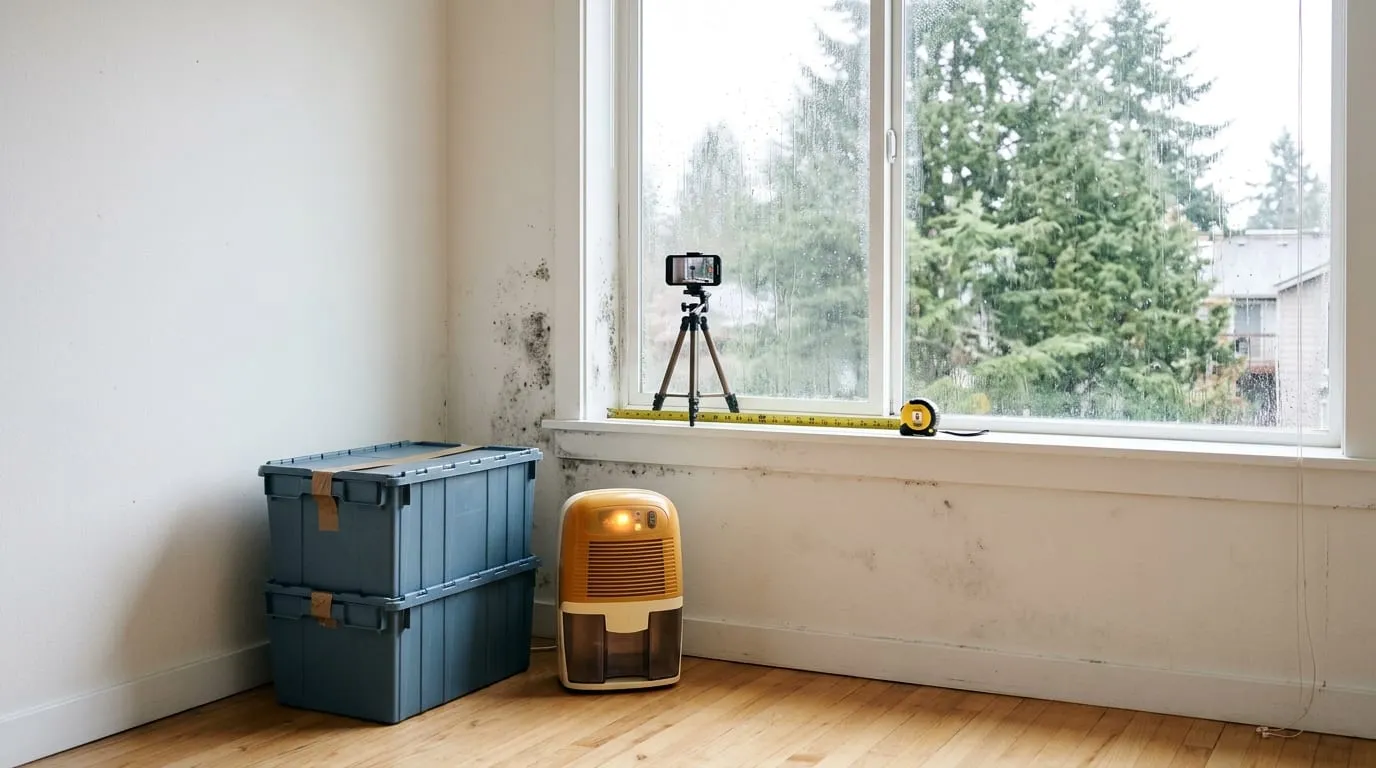
- Photograph with scale. Lay a tape measure next to the growth and shoot wide (whole wall) and close (the patch). Repeat weekly on the same day.
- Record the moisture source. Video of water coming in during rain, a dripping trap, or a fan that does not move air.
- Log humidity. EPA recommends keeping indoor humidity “below 60 percent (ideally between 30 and 50 percent).” An inexpensive hygrometer reading in your photos shows you were managing what you could.
- Keep every message. Your written notice, the landlord’s replies, repair appointments, and missed visits.
- Note health effects factually. The Department of Health says people with allergies or asthma may be more sensitive to mold and suggests consulting a physician if you suspect mold-related health problems.
The same habits are covered in more depth in how to document your apartment’s condition.
Cleaning small areas safely
Both EPA and the Department of Health say a moldy area under about 10 square feet (roughly a 3 foot by 3 foot patch) is usually something you can clean yourself, and that larger areas, sewage contamination, or hidden mold call for a professional. The Department of Health also says not to paint or caulk over mold, because it keeps growing underneath.
For surface technique on condensation-prone window sills and frames, see the Seattle Cleaning Guide’s walkthrough on preventing and removing mildew on window sills. Never mix cleaning products, and follow the label.
Cleaning small condensation spots is the tenant’s part; it does not replace a repair when the water comes from the building.
An illustrative scenario
Consider a hypothetical renter in a 1960s basement one-bedroom in Seattle. In December she notices black spots spreading on the bedroom wall below the window, plus a brown ceiling stain in the bathroom under the upstairs unit’s tub.
The window wall gets wet only after heavy rain, even though she runs the heat and wipes condensation, so she suspects the window seal. The bathroom stain grows after the upstairs neighbor showers, which points to plumbing.
She photographs both with a tape measure for scale, records a hygrometer reading of 58 percent, and writes one dated notice to the property manager who collects rent. It gives the address, the owner’s name from her lease, and describes each defect by location and water source. She keeps a copy and delivers it the way her lease specifies.
Under RCW 59.18.070, neither defect cuts off heat, water, or a major fixture, so the landlord has 10 days to start remedial action on each. A plumber fixes the upstairs drain on day six. The window repair is scheduled but missed twice, so on day 20 she calls the Renting in Seattle helpline. She keeps paying rent throughout and logs every exchange, which keeps her within RCW 59.18.080 and gives her a clean record for the move-out inspection. She keeps cleaning the small spots on the wall and sill in the meantime.
When you move out
If mold damage traces back to a building defect you reported, your written notice and photos are the evidence that the condition was caused by the landlord’s failure, not by you. Deposit deductions have their own rules; see what landlords can and cannot deduct from security deposits. When you move into your next place, note any staining, musty smells, or soft drywall on the move-in checklist, as covered in the move-in cleaning and inspection checklist.
Common questions
Does Washington law require my landlord to test for mold?
No testing duty appears in chapter 59.18 RCW. The Department of Health says sampling is usually unnecessary because in most cases you can see or smell mold. What matters for a repair request is the moisture source behind it, such as a leak or a failed seal.
Can I stop paying rent until the mold is fixed?
The City of Seattle warns that withholding rent is risky and could lead to eviction. RCW 59.18.080 also says a tenant must be current on rent, including utilities they agreed to pay, before using the remedies in the chapter. The rent escrow process in RCW 59.18.115 is a separate, formal procedure with an inspection and sworn notice, not the same as simply not paying.
My landlord never gave me any mold information. Does that matter?
RCW 59.18.060 requires landlords to provide Department of Health approved mold information to new tenants when the lease is signed, or post it in a visible public spot on the property. The same section limits a landlord's civil liability for missing it to cases where the failure was knowing and intentional, so it is worth noting but rarely the main issue.
Will the City of Seattle inspect a mold problem?
The City says you can call the Renting in Seattle helpline at (206) 684-5700 or file an online complaint about repairs that are not getting fixed, and an inspector will visit and contact the landlord. The Department of Health notes that code officials generally act on building problems, not mold itself, so describe the leak or moisture source.
Sources and references
- RCW 59.18.060: Landlord, Duties , Washington State Legislature Primary source Accessed November 15, 2026
- RCW 59.18.070: Landlord, Failure to perform duties, Notice from tenant, Time limits for landlord's remedial action , Washington State Legislature Primary source Accessed November 15, 2026
- RCW 59.18.080: Payment of rent condition to exercising remedies, Exceptions , Washington State Legislature Primary source Accessed November 15, 2026
- RCW 59.18.090: Landlord's failure to remedy defective condition, Tenant's choice of actions , Washington State Legislature Primary source Accessed November 15, 2026
- RCW 59.18.280: Moneys paid as deposit or security, Statement of basis for retention, Remedies , Washington State Legislature Primary source Accessed November 15, 2026
- RCW 59.18.100: Landlord's failure to carry out duties, Repairs effected by tenant, Procedure, Deduction of cost from rent, Limitations , Washington State Legislature Primary source Accessed November 15, 2026
- RCW 59.18.115: Substandard and dangerous conditions, Notice to landlord, Government certification, Escrow account , Washington State Legislature Primary source Accessed November 15, 2026
- RCW 59.18.130: Duties of tenant , Washington State Legislature Primary source Accessed November 15, 2026
- RCW 59.18.240: Reprisals or retaliatory actions by landlord, Prohibited , Washington State Legislature Primary source Accessed November 15, 2026
- Mold , Washington State Department of Health Primary source Accessed November 15, 2026
- Renters, Landlords, and Mold , Washington State Department of Health Primary source Accessed November 15, 2026
- A Brief Guide to Mold, Moisture and Your Home , U.S. Environmental Protection Agency Primary source Accessed November 15, 2026
- Mold Cleanup in Your Home , U.S. Environmental Protection Agency Primary source Accessed November 15, 2026
- Repair Requests , City of Seattle, Renting in Seattle Primary source Accessed November 15, 2026
- Renting in Seattle , City of Seattle Primary source Accessed November 15, 2026
- How to Prevent and Remove Mildew on Window Sills and Frames , Seattle Cleaning Guide Accessed November 15, 2026
See something out of date or wrong? Tell the editors. Read how we work in our editorial policy.